
A 12-week half marathon training plan should build from the running you already do, include recovery, and reduce training before race day. Use this 2026 week-by-week framework to organize your preparation for 13.1 miles, then adjust each week to your current ability, available days and response to training—not to an unfinished mileage target.
- A half marathon training plan needs a starting point, a race date, manageable long runs and recovery.
- Kiki is best for iPhone runners who want a personal training plan that adapts around their schedule.
- Use the 12-week framework as a sequence, not permission to jump beyond your current running.
- Missed runs do not become training debt. Reassess the week instead of squeezing everything together.
The 12-week half marathon training plan, week by week
Start with your recent training, not the biggest week you hope to complete. A half marathon covers 21.0975 kilometers, usually rounded to 21.1 kilometers or 13.1 miles. Your preparation needs to make that distance a sensible next goal.
If you want the schedule personalized rather than filling in a template yourself, Kiki builds and adapts running plans for iPhone. The framework below explains the training decisions you still need to understand.
This is a sequence of weekly priorities, not a fixed-distance prescription. Each row tells you what to assess before moving ahead; it does not require you to increase your running every week.
| Week | Main priority | What the week should accomplish | Adjustment checkpoint |
|---|---|---|---|
| Week 1 | Establish your baseline | Start from recent, repeatable running | Reduce the proposed load if it exceeds what you currently manage |
| Week 2 | Repeat the routine | Confirm that running fits your available days | Keep the week similar if recovery feels incomplete |
| Week 3 | Build cautiously | Extend manageable training without changing everything at once | Hold progression if easy runs feel unusually hard |
| Week 4 | Review recovery | Check whether the opening weeks remain manageable | Reduce training when fatigue is accumulating |
| Week 5 | Develop endurance | Give the long run a clear place in the schedule | Protect recovery around the longer session |
| Week 6 | Review the race goal | Compare your progress with the demands of the event | Reconsider expectations if the plan repeatedly exceeds your ability |
| Week 7 | Keep training repeatable | Continue endurance work without chasing missed sessions | Remove catch-up running from the schedule |
| Week 8 | Reassess the workload | Check sleep, energy and how you feel between runs | Hold or reduce training rather than forcing progression |
| Week 9 | Prepare for race demands | Practice familiar equipment and fueling during suitable runs | Avoid introducing several unfamiliar changes together |
| Week 10 | Finish the main build | Review readiness and the timing of your final demanding sessions | Do not add a late endurance test to prove fitness |
| Week 11 | Reduce accumulated fatigue | Follow the plan's reduction in training | Resist replacing reduced volume with harder efforts |
| Week 12 | Arrive ready to race | Keep preparation familiar and organize race-day details | Do not cram unfinished training into race week |
The week numbers provide structure, not a deadline for adaptation. If your preparation stalls, revise the plan or the race goal rather than forcing the next row.
Why this matters
A calendar can say you have 12 weeks. It cannot tell you whether your current running supports the first week of a particular plan. That distinction matters more than whether the plan looks detailed.
For a 2026 race, work backward from the event date, then check the opening workload against your recent training. A schedule that immediately asks for substantially more running needs adjustment before you begin.
The right starting week is one you can complete and recover from. Being able to finish a demanding session does not automatically make that session a sensible foundation for the following week.
Before week 1: check your starting point
Write down what you actually did recently. Include completed runs, walking breaks, rest days and any interruptions. Do not substitute the routine you intended to follow.
Then answer these questions:
- Current running: What running have you repeated comfortably, rather than completed once?
- Available days: Which days genuinely work around your job, family and travel?
- Race goal: Are you preparing to finish, use run-walk intervals or pursue a time goal?
- Long-run space: Where can a longer session fit without crowding demanding days together?
- Recovery: Are you returning to normal between sessions, or carrying fatigue into the next run?
If you are starting from no running, a beginner running phase is a more appropriate starting point than assuming a half marathon deadline will create readiness. Choose the preparation your current ability supports.
Do not set a race pace simply by choosing an appealing finish time. Your current running should inform the goal, not the other way around.
How to use the opening weeks
The opening weeks establish whether your plan fits real life. Keep easy running conversational: you should be able to speak in sentences without fighting for breath. Slow down or use walking breaks when needed.
Pay attention to the whole week. A long run that leaves you unable to manage the remaining sessions is evidence that the schedule needs changing, even if you completed that run.
Avoid increasing distance, frequency and intensity together. Changing several demands at once makes it harder to identify what is leaving you tired.
For your 2026 plan, keep a brief note after each session: manageable, too hard, unusually tired or something hurts. These observations give the next training decision useful context without turning your running into a spreadsheet.
How to handle the middle weeks
The middle of the plan is about repeatable endurance, not collecting impressive individual workouts. Give the longer run enough space that you can recover before another demanding session.
Use suitable training runs to practice the equipment and fueling you intend to use during the race. Familiarity matters. Race day is not the place to discover that your chosen socks rub or that carrying your supplies is awkward.
If your plan includes faster running, judge it alongside the long run and the rest of the week. A session is not useful simply because it feels hard; it needs to fit the training you can absorb.
When you are struggling to recover, simplify the week before adding more work. Completing fewer well-placed sessions is a better decision than preserving every box on a calendar at any cost.
How to finish the plan without cramming
The final part of preparation should reduce fatigue rather than create a last-minute fitness test. Tapering means reducing training before the race; it does not mean replacing shorter runs with harder ones.
The timing of your final long run belongs in the context of your full plan. Do not copy another runner's date without considering their training history, workload and recovery.
Keep race-week decisions practical. Check your event instructions, transport, familiar clothing and what you plan to eat and carry. None of those tasks requires an extra demanding run.
If you reach the closing weeks with a substantial gap in preparation, reassess the race goal. An unfinished block cannot be repaired by compressing it into the days before the start.
Why a half marathon training plan varies
A useful plan changes because the runner and the calendar change. These are the main inputs that should shape your schedule:
- Current ability: Recent, repeatable training sets the starting workload. Ambition does not replace it.
- Available days: A plan needs to fit the days you can train, including room between demanding sessions.
- Race goal: Preparing to finish and pursuing a time goal create different planning decisions.
- Training response: Persistent fatigue or repeatedly difficult easy runs call for reassessment.
- Missed sessions: Travel, work and family commitments change what fits. Missed work should not automatically move forward.
- Discomfort: Something hurting changes the decision. Do not treat pain as a scheduling problem to push through.
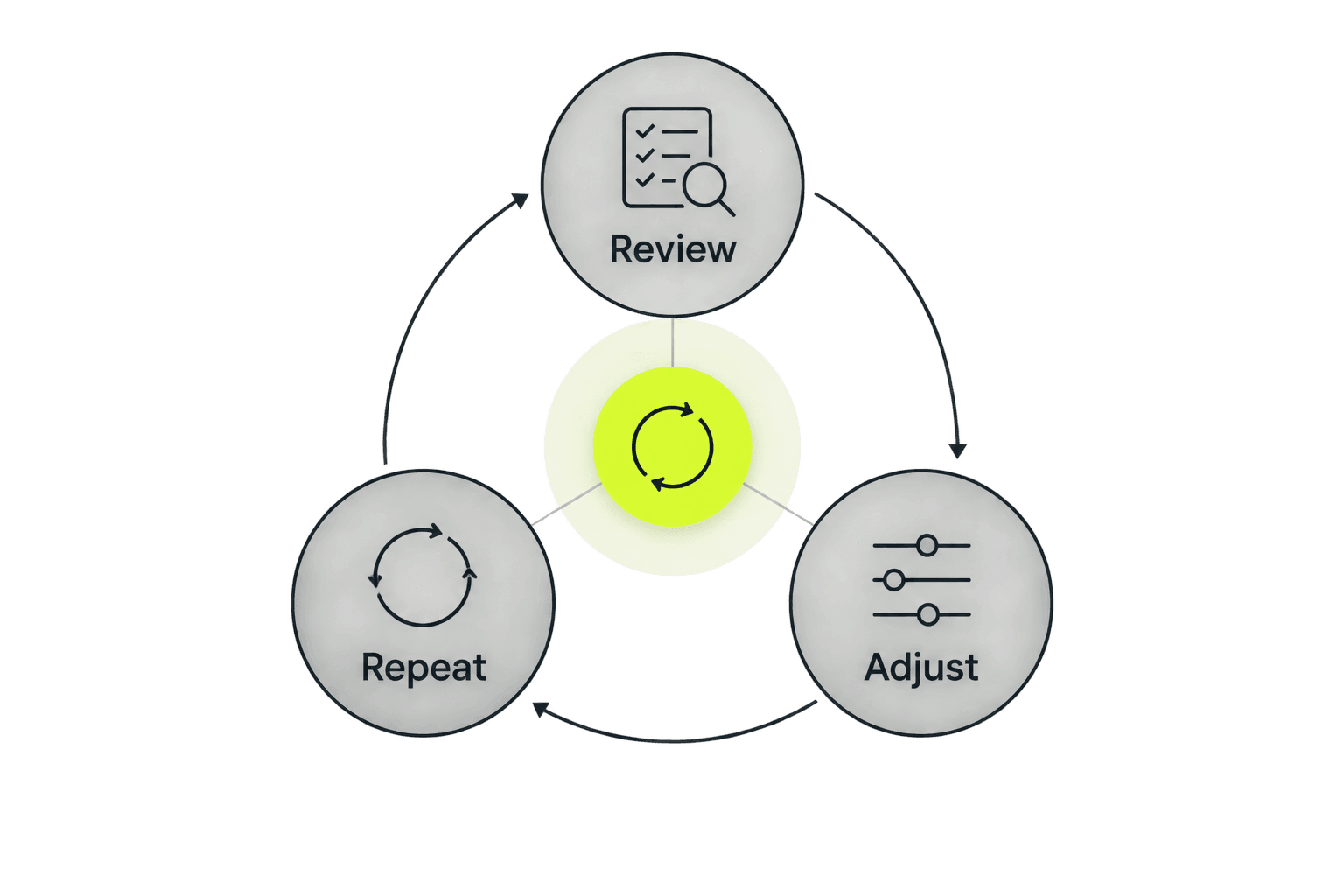
Use a check-adjust-repeat routine
After a disrupted or unusually difficult week, assess what happened before choosing the next session. Follow this sequence instead of immediately rearranging every missed run.
- Review: Compare completed training with how you feel now.
- Adjust: Keep, reduce or rearrange the remaining training to match your available time and recovery.
- Repeat: Reassess after the next sessions rather than assuming the revised schedule must stay fixed.
If something hurts, stop the session rather than trying to preserve the schedule. Persistent or concerning pain needs assessment from a qualified healthcare professional, not a harder training adjustment.
Should you use an adaptive app or a static plan?
Choose the format around the help you need. In 2026, the useful distinction is not whether a plan appears on a screen or on paper; it is how you make decisions when training stops matching the original schedule.
| Option | Best for | Useful strength | Trade-off to consider |
|---|---|---|---|
| Kiki | iPhone runners wanting an adaptive personal plan | Builds and adapts training around personal needs | The stated app platform is iPhone; useful personalization needs accurate information |
| Runna | Runners considering app-based structured training | Offers personalized running plans | Check the current features against the adjustments and support you need |
| Nike Run Club | Runners who value guided-run audio | Offers guided runs and training plans | Check whether the available plan format fits your race and schedule |
| Free static plan | Runners comfortable making their own adjustments | Provides a schedule you can inspect in advance | You are responsible for deciding what changes after missed runs or fatigue |
A static plan is not automatically a poor choice. Its limitation is that the document cannot interpret your week for you. If you understand how to adjust training and prefer that responsibility, the format can suit you.
An app does not remove your responsibility to report what happened. A completed workout, a skipped workout and a run that felt too hard are different pieces of information. Keep those distinctions clear when reviewing your plan.
Build your personal running plan
See how a plan can fit your goal, current ability and available days. Download for iPhone from the site.
Is 12 weeks enough to train for a half marathon?
12 weeks is a planning window, not a guarantee of readiness. It needs to fit your starting ability, recent consistency and race goal. If the opening workload is already beyond your current running, choose a longer preparation period or reconsider the event date.
How far is a half marathon in miles and kilometers?
13.1 miles is the commonly used rounded half marathon distance; the official distance is 21.0975 kilometers. Keep your training units consistent so that a distance entered in miles is not mistaken for kilometers. The race distance alone does not determine your long-run prescription.
What should you do if you miss a week?
Reassess before resuming the original schedule. Consider why you missed training, what you last completed comfortably and how you feel now. Do not combine the missed week with the next one.
FAQ
Can I use a half marathon training plan if I am a beginner?
A beginner needs a half marathon training plan that starts from their actual running ability. If you are not running yet, establish a manageable beginner routine before treating a race-specific schedule as your starting point.
Do I have to run the full half marathon distance in training?
Running the full half marathon distance in training is not a universal requirement. Your longest session should fit your preparation, overall workload and recovery rather than serve as a compulsory rehearsal.
Can I use walking breaks during half marathon training?
Yes, walking breaks can be part of half marathon training. Include them deliberately and check your event's published cutoff rules when deciding whether the race fits your expected approach.
What should I change if every easy run feels hard?
Reduce the demand and reassess the plan if every easy run feels hard. Check recent workload and recovery instead of treating the prescribed pace as something you must force.
Can Kiki help me prepare for a half marathon on iPhone?
Kiki builds and adapts personal running plans for iPhone, including preparation for race goals. Provide your current ability and available training days so the plan starts from your situation.
Should I keep training when something hurts?
Do not push through pain to complete a scheduled run. Stop the session and seek qualified healthcare advice for persistent or concerning pain rather than relying on a training plan to assess it.
One last thing
Before saving your 2026 schedule, choose what you will do when a session no longer fits. Decide who or what will help you reassess it, and keep that process simple enough to use when you are tired.
A missed run is a planning decision, not a debt. The next useful session is the one that fits your current preparation—not the one that makes the calendar look complete.


