
Adjust your personalized running plan after a missed run by checking why you missed it, what session it was and what comes next. Skip, move or shorten the session without crowding harder runs together or cutting recovery. A missed run is not a debt you have to repay.
- Adjust your personalized running plan around recovery and upcoming sessions, not a need to complete every calendar entry.
- Skip a missed easy run when moving it would crowd the rest of your week.
- Move a long run only when you can also protect recovery around it.
- Kiki suits iPhone runners who want a personal training plan that adapts when their schedule changes.
Why this matters
A training calendar tells you what was planned. It does not tell you whether yesterday's workout still fits today. Adding a missed session without changing anything else makes the week different from the plan you originally agreed to follow.
Kiki is best for iPhone runners who want a personalized running plan that adapts around their goal, current ability and available days. You can explore Kiki if changing the calendar yourself is the part you want help with.
Whether your target is a 5K, a 10K or a first marathon in 2026, the next useful decision is the same: choose work that fits your current week. Do not protect an old calendar entry at the expense of the next session.
How do you adjust a personalized running plan after a missed run?
Start with the reason for the miss, then check the sessions on either side of the proposed replacement. The right adjustment preserves the purpose of your training without pretending the missed day is still available.
- Name the reason. A work meeting, unusual tiredness and pain call for different responses.
- Identify the session. Was it an easy run, a harder workout or a long run?
- Check the next commitment. Look for another demanding session, a fixed race date or a day you cannot run.
- Choose an adjustment. Skip, move or shorten the run based on what the revised week actually contains.
- Update the rest of the week. A moved session changes what fits around it. Do not edit that day in isolation.
Use this comparison before changing the calendar:
| Adjustment | Best for | Benefit | Trade-off |
|---|---|---|---|
| Skip | An isolated missed run when the remaining week still fits | Keeps the existing recovery gaps | You do not complete that session |
| Move | A scheduling conflict with room elsewhere | Retains the session's original purpose | Other sessions might need to move or disappear |
| Shorten | A smaller time window when you otherwise feel ready | Fits some running into the available time | Does not provide the same session as originally planned |
| Rebuild the week | Repeated misses or changed availability | Makes the schedule match your actual commitments | Requires reconsidering priorities rather than shifting one entry |
Choose the adjustment by its effect on the whole week, not by how tidy it makes the calendar. A complete-looking schedule is not the goal.
Missed an easy run: skip the catch-up
If an ordinary scheduling problem cost you an easy run, resume the plan when you next have a suitable opportunity. Do not automatically add its distance to the next outing. That turns the next session into something different.
Moving an easy run is an option when a genuine gap exists. Check that the gap was not intended for recovery and that the change does not create a sequence you would normally avoid.
For example, suppose a meeting takes your planned run slot and the following day is already busy. Leave the missed run behind rather than stretching another session simply to match the weekly total. You are making a schedule decision, not failing a test.
For a first 5K in 2026, keeping the plan manageable matters more than preserving every calendar entry. Repeatedly needing to squeeze runs into unavailable days is a reason to change the plan itself.
Missed a harder workout: do not stack demanding sessions
A missed interval or sustained faster session does not belong wherever an empty calendar box appears. Look at the long run and any other demanding training before moving it. An open evening does not automatically mean you are ready for that workout.
If moving the workout crowds another demanding session, drop or revise something instead of keeping everything. Do not attach the missed faster running to an easy outing and still treat that outing as recovery.
The benefit of moving the workout is clear: you retain a session with a specific purpose. The downside is equally important: keeping it can displace recovery or another useful session. Preserve the training purpose, not every item on the list.
If the workout was missed because the previous session felt too hard, reassess before rescheduling it. That is different from missing it because your train was late.
Missed a long run: review the surrounding days
Before moving a long run, look at what comes before it and what follows it. You need enough time to complete the session without rushing, plus room afterward to recover. Moving the run while keeping every other session unchanged ignores that second requirement.
Do not combine the missed distance with the next long run. The next long run should be chosen for your current training, not enlarged to settle last week's total.
For a first marathon, a missed long run can feel more serious than a missed short outing. Use that concern to review the plan, not to force the run into a poor slot. The guide to choosing a marathon training app for your first race can help you assess what support you want when training changes.
If your race is close, do not insert a replacement long run without considering the planned reduction in training before race day. Being behind on the calendar is not a reason to abandon recovery.
Why your missed-run adjustment varies
There is no useful rule that says every missed run must move to the following day. Your adjustment depends on the reason for the miss and the space available around it.
- Reason: A calendar conflict is not the same problem as feeling unusually tired or having pain.
- Session: An easy outing, a harder workout and a long run have different purposes.
- Recovery: Consider how you feel after recent training before adding another session.
- Availability: Use the time you actually have, not the time you wish you had.
- Race proximity: A change near race day needs to account for the planned reduction in training.
- Pattern: An isolated disruption needs a different response from a schedule that repeatedly fails to fit.
These factors work together. A movable session still needs a suitable place, and a suitable calendar opening still needs a runner who is ready for the work.
Use a quick check before your next run
For your next training week in 2026, make the adjustment before you get dressed to run. Decide what the session is for while you still have the whole calendar in view. Avoid negotiating extra distance with yourself halfway through an outing.
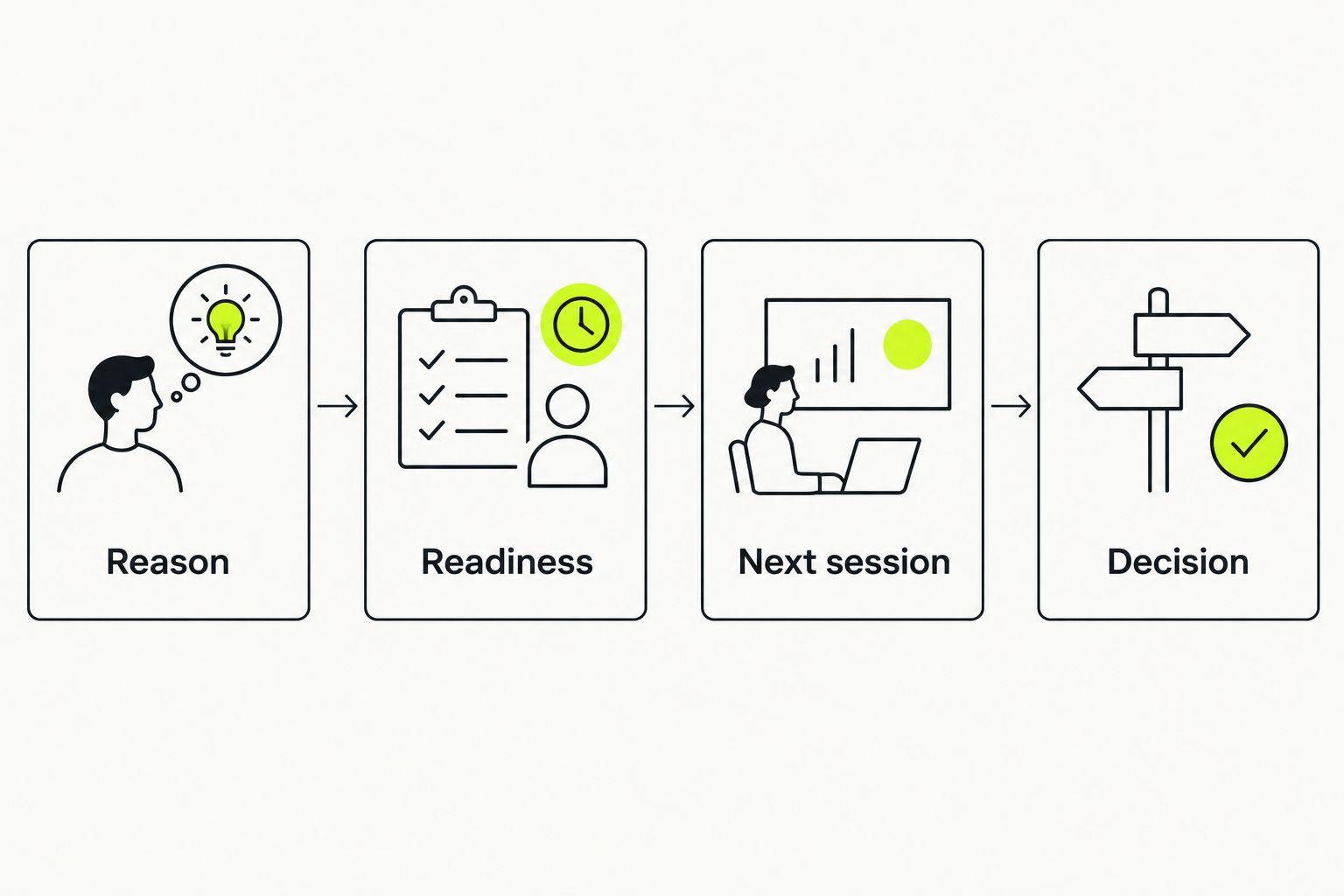
Work through these checks in order:
- Reason: Was the miss about time, tiredness or something hurting?
- Readiness: Do you feel ready for the session you are considering?
- Next session: Would the change crowd another demanding run?
- Decision: Skip, move, shorten or rebuild the week.
Suppose Tuesday's easy run is missed because of work, Thursday contains a harder session and the weekend contains your long run. Moving Tuesday's run to Wednesday is not automatically the right answer. Check whether Wednesday was meant to be a recovery day and whether the revised sequence still suits you.
These are example calendar positions, not a recommended weekly schedule. Your available days and recent training decide what fits.
What if you missed the run because you felt tired?
Tiredness is a reason to reconsider the planned work, not just find a new time for it. Ask whether you missed the session because life was busy or because you did not feel ready to run. Those can happen together, but they are not interchangeable.
Do not turn an easier day into a harder one simply because you now have time. If unusual tiredness continues, step back from the calendar and seek appropriate advice rather than repeatedly forcing the next workout.
If something hurts, do not use a catch-up run to test how much you can tolerate. Stop an activity that causes pain and get qualified medical advice when needed. An app's schedule does not establish whether running is appropriate.
What if you keep missing the same run?
A repeated miss is a planning problem worth fixing. If a particular evening rarely works, remove it from your assumed availability. Build around the days you can usually protect.
Review your 2026 race goal alongside that real schedule. A plan based on imaginary free time will keep producing the same conflict, even if each individual workout looks reasonable.
Give an adaptive app concrete information: your goal, current ability, available days and what prevented the session. “I can't run on that day” is more useful than repeatedly moving a run into the same unreliable slot.
An adaptive plan can help organize changes. Its limit is that you still need to communicate what happened and judge whether you are ready to train; a revised calendar is not permission to ignore how you feel.
Build a plan around your week
Explore Kiki for iPhone and a personal running plan that adapts around your training and schedule.
Should I make up a missed run the next day?
No, a missed run does not automatically move to the next day. Move it only after checking readiness, recovery and the sessions around it; otherwise, skip or revise it.
Should I restart my plan after missing a week?
A missed week calls for a review, not an automatic restart or an automatic jump back into the calendar. Consider why you stopped, how much running you have recently completed and whether the upcoming sessions still fit your current ability.
Can I still follow my plan if my race is getting close?
A fixed race date does not make missed training recoverable on demand. Review the remaining plan and your goal rather than adding work simply because the event is approaching.
FAQ
What's the best way to adjust a personalized running plan after a missed run?
Check why you missed the run, what type of session it was and what comes next. Skip, move or shorten it without crowding demanding sessions together or removing needed recovery.
Should I add missed miles to my next run?
Do not automatically add missed miles to your next run. That changes the next session's workload instead of restoring the original plan.
Can I move my long run to another day?
You can move a long run when the surrounding schedule and your readiness support it. Review the sessions before and after it rather than moving only the long-run entry.
What should I do if I miss an interval workout?
Check the next demanding session before rescheduling an interval workout. If moving it crowds the week, drop or revise another session instead of stacking the work.
What if I missed a run because something hurts?
Do not schedule a catch-up run to push through pain. Stop an activity that causes pain and seek qualified medical advice when needed.
Can Kiki help when my running schedule changes?
Kiki builds and adapts personal running plans for iPhone users. Base your plan on your goal, current ability and available days rather than a schedule you cannot consistently follow.
Do I need to restart after missing one run?
One missed run does not by itself call for restarting your plan. Review the next session and adjust the week according to why you missed the run and how you feel.
One last thing
For your next missed run in 2026, write down the reason before changing the calendar. “Work ran late” points to scheduling; “too hard” points to the training; “something hurts” calls for caution. The reason for the miss is more useful than the empty box it leaves behind.


