
Stop long runs when your half-marathon taper begins, using the final long-run date in your training plan rather than a universal day count. Keep the remaining sessions shorter, and do not squeeze a missed long run into race week. Stopping long runs does not mean stopping all running.
- When to stop long runs before half marathon: follow your taper, not another runner’s calendar.
- Keep shorter, easy runs in your taper when your plan calls for them.
- Do not turn a missed long run into a race-week catch-up session.
- Kiki suits iPhone runners who want a personal training plan that adapts around their schedule.
How many days before a half marathon should you stop long runs?
Use the final long run scheduled before your taper as your cutoff. A useful plan sets that session in the context of your previous training, your race date and the shorter runs that follow. The date alone is not enough to judge the session.
For your 2026 race, work backward from race day:
- Find the taper. Look for the part of your plan where the total amount of running decreases before the race.
- Identify the final long run. Check its place in the schedule, not just its distance.
- Keep the shorter sessions shorter. Do not add the removed distance somewhere else.
- Leave missed mileage behind. A session you missed earlier does not automatically belong in the final week.
Kiki builds and adapts personal running plans for iPhone runners. If you use a personalized plan, follow the current schedule rather than an older version you saved before your training changed.
The final long run is part of your preparation, not a last-minute test of whether you deserve to start. You do not need to turn it into a race rehearsal at maximum effort.
Why this matters
The taper changes the job of your training. Earlier sessions build your preparation; the closing stretch reduces the amount of running before the event. Adding extra distance because the schedule looks light works against that change.
This is where runners often face a practical problem. You miss a weekend run, see an open evening in race week and want to move the whole session there. The calendar has room, but the session no longer sits in the same training context.
Think of your 2026 race schedule as a sequence, not a checklist. Moving a demanding run changes what comes before and after it. Completing every box is not the goal.
You can still have useful running left after your final long run. Shorter sessions let you follow your routine without repeating the biggest session in the plan.
Why your final long-run date varies
Your final long-run date should reflect the runner doing the session. Two people entering the same half marathon do not automatically need matching schedules.
These are the details to consider:
- Your current ability. A familiar session and a substantial increase are different demands. Judge the proposed run against training you have actually completed.
- Your race goal. Preparing to finish your first half marathon is a different planning task from working toward a specific finishing time.
- Your available days. Work, travel and family commitments affect where sessions fit. Moving a run should not mean ignoring the rest of the week.
- How training feels. Being tired or finding sessions too hard is information to act on, not something to hide from your plan.
- Interruptions to the schedule. A missed run changes the record of what you completed. It does not create an obligation to repay the distance.
Give these details more weight than a countdown shared by someone whose training you do not know. A screenshot of another runner’s final week leaves out the weeks that led to it.
When reviewing your 2026 plan, use your current situation. The schedule you could manage when you entered the race is not necessarily the schedule you can manage now.
What should replace long runs during your taper?
Follow the shorter sessions and rest days already set out in your plan. Do not replace every removed mile with another workout. Reduced running is the point of the taper, not a gap that needs filling.
The main choices serve different purposes:
| Session | Best for | Benefit | Limit or caution |
|---|---|---|---|
| Final scheduled long run | Completing the long-run portion of your plan before tapering | Keeps the session in its intended place | Moving it later changes the surrounding schedule |
| Short easy run | Keeping a familiar running routine during the taper | Lets you run without repeating the long session | Adding distance or racing the route changes the session |
| Rest day | Following planned time off from running | Keeps the day free of another run | Do not turn it into an unplanned hard workout |
An easy run should not become a fitness test because race day feels close. Follow the intended effort rather than chasing a reassuring pace on your watch.
Likewise, do not make a rest day harder just because you feel restless. A demanding replacement workout still adds work, even when it is not running.
Check what the session is supposed to achieve before changing it. If your only reason for adding more is that the taper feels unfamiliar, keep the original purpose in view.
What if you miss your final long run?
Do not automatically move a missed final long run into race week. First review where you are in the plan and what remains before the start. A missed session calls for a schedule decision, not an automatic catch-up run.
Use this sequence:
- Check the calendar. Confirm the race date and whether your taper has already started.
- Review completed runs. Look at what you actually did, including sessions you shortened or skipped.
- Adjust the plan. Use your coach or your plan’s adjustment process instead of inserting the full run yourself.
- Protect the taper. Keep the closing stretch from becoming a collection of postponed workouts.
The same sequence applies whether the interruption came from work, travel or a weekend that simply got away from you. Start with the present schedule rather than trying to recreate the original one.
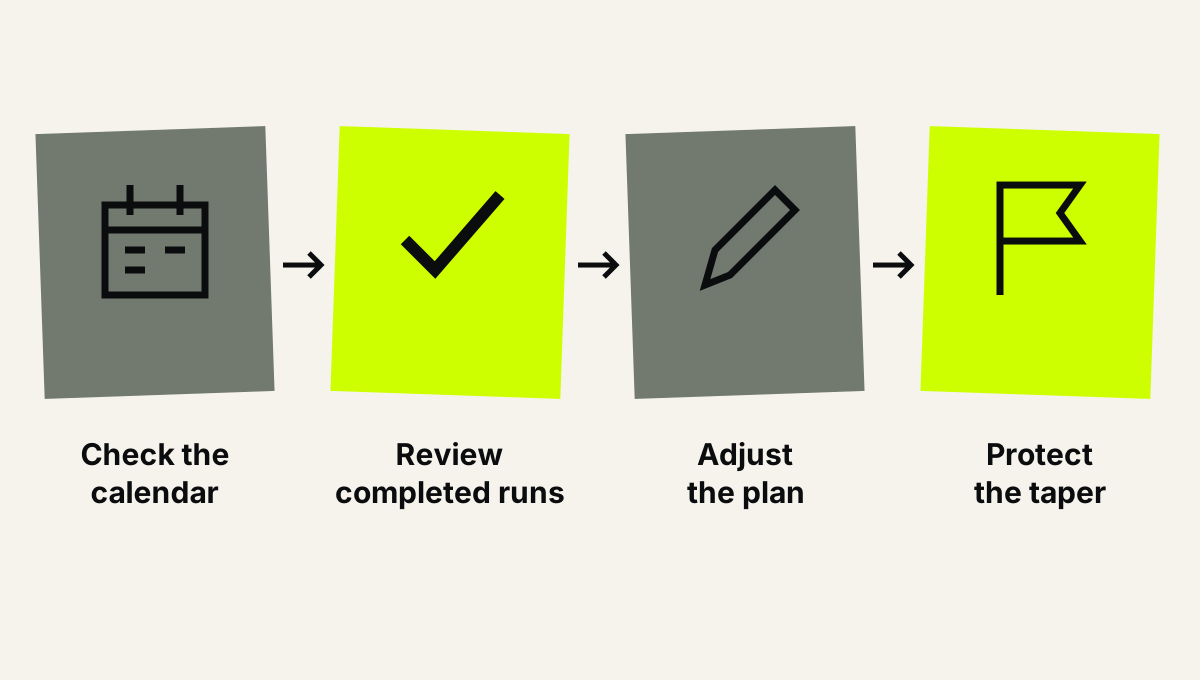
Review the whole schedule before moving a missed long run.
Missing the final long run and missing a substantial part of your preparation are also different situations. If training has been repeatedly interrupted, review the race plan itself rather than expecting one large session to settle the question.
Be honest about the record. A planned run is not a completed run, and an app calendar should reflect that distinction.
How should you handle a long run that feels too hard?
A difficult final long run is not a reason to repeat it before race day. Record what happened and use that information when reviewing the remaining schedule.
Be specific. “Too hard” is useful; “the opening felt comfortable, then I struggled to keep the planned effort” gives more context. Note whether you completed the session, shortened it or stopped.
Do not respond by adding another test run to prove that the first one was a mistake. That creates another demanding session without answering why the original run felt difficult.
If something hurts, stop the session rather than using the taper calendar as permission to continue. Seek appropriate medical advice about pain or symptoms; a training adjustment is not an assessment of what is wrong.
For a 2026 half marathon, your most useful record is the training you have completed and how it felt. Keep that record accurate, even when it is less tidy than the original plan.
How do you put the final long run on your calendar?
Start by marking the race date clearly. Then identify the final long run and the shorter sessions that follow it. Look at the whole closing stretch before moving anything.
Suppose your race is on Sunday and your usual long-run day is Sunday. That habit does not mean every Sunday must remain a long-run day right up to the event. Once the taper starts, the session’s purpose changes.
Now check your real commitments. If work removes your usual running slot, ask whether the session should move, shorten or be removed through your plan’s adjustment process. Do not assume the longest session takes priority over everything else.
Before saving a change, ask:
- Am I following the current plan or an outdated version?
- Am I moving this run because it fits the training, or because I dislike leaving it unfinished?
- Have I quietly added distance to the sessions around it?
- Does the updated schedule reflect how tired I feel?
Write the final decision in one place. Keeping several conflicting calendars makes it harder to know which session you are supposed to follow.
Should you stop all running after the final long run?
Stopping long runs is not the same as stopping all running. Follow the shorter runs and rest days in your taper instead of treating the final long run as the end of the entire schedule.
Avoid the opposite mistake, too. Keeping some running does not mean keeping the same total distance or turning every remaining outing into a hard effort.
If your plan includes a short easy session, keep it recognizably short and easy. Do not extend it because you feel good halfway through. Feeling ready does not create a requirement to demonstrate more fitness before the start.
Do you need to cover the race distance beforehand?
Do not add a full-distance rehearsal just to settle pre-race nerves. Whether your preparation includes that distance is a decision for the training plan, not an extra requirement to invent during the taper.
A 5K plan, a 10K plan and a half-marathon plan do not have to use the same relationship between training runs and race distance. Follow the preparation for the event you are entering.
If you want reassurance, review the sessions you completed and the race-day instructions in your plan. Another long run is not the only way to prepare your decisions for the start line.
What if your training plan no longer fits your week?
A fixed schedule can give you a clear sequence to follow. Its limitation is practical: when your circumstances change, the printed sessions remain the same until someone adjusts them.
An adaptive app is relevant when your available days, current ability or training feedback need to change the schedule. That does not remove your responsibility to report what happened accurately.
Kiki is best for iPhone runners who want a personal running plan that adapts around their goal and available days. The limitation is clear: it is training guidance, not a medical assessment or a promise about your race result.
If that matches how you want to prepare, visit the site to download Kiki for iPhone. Use the plan to organize the remaining training, not to justify adding more whenever you feel uncertain.
For your 2026 race, the useful question is not whether the calendar looks ambitious. It is whether the current plan matches the running you have done and the days you can actually train.
FAQ
When should I stop long runs before a half marathon?
Stop long runs when your half-marathon taper begins, following the final long-run date in your training plan. Keep the remaining sessions shorter rather than adding another long effort.
Can I do my missed long run during race week?
Do not automatically move a missed long run into race week. Review the remaining schedule with your coach or through your plan’s adjustment process instead of inserting the full session yourself.
Should I stop running completely before my half marathon?
Stopping long runs does not mean stopping all running. Follow the shorter runs and rest days in your taper rather than replacing the whole schedule with either complete rest or extra workouts.
What if my last long run felt much too hard?
Record the difficult session and review the remaining plan instead of repeating the long run. Include what you completed, how the effort felt and whether you shortened or stopped the session.
Should I run the full half-marathon distance before race day?
Do not add a full-distance rehearsal simply for reassurance. Follow your training plan’s long-run progression rather than creating a new requirement during the taper.
Can I use a running app to adjust my half-marathon plan?
An adaptive running app can help organize training around changes to your schedule. Kiki builds and adapts personal running plans for iPhone runners; it does not replace medical advice about pain or symptoms.
What should I do if something hurts during my final long run?
Stop the session if something hurts rather than pushing through to finish the planned distance. Seek appropriate medical advice about pain or symptoms before treating the problem as a scheduling issue.
One last thing
Put a clear label beside your final long run: “Do not move into race week without reviewing the plan.” That small calendar note gives you a decision rule when work, travel or nerves disrupt the schedule.
Then leave the taper room to be a taper. You do not need to fill every space the plan deliberately leaves open.


