
Review a personalized running plan by checking its starting workload, race goal, weekly schedule, effort instructions, and rules for missed sessions. The first week should reflect what you can do now, not what you hope to manage later. Before you start, resolve any mismatch between the plan and your actual time, recent running, or recovery needs.
- A personalized running plan should match your recent running, race goal, and available training days.
- Kiki suits iPhone runners who want an adaptive running plan rather than a fixed schedule.
- Check the opening week before judging the race-day target.
- Know what changes when you miss a run, feel tired, or find a session too hard.
Why this matters
A training calendar can look organized and still be wrong for your week. Putting your name and race date at the top does not establish whether the sessions fit your current ability.
For your 2026 race, review the assumptions before accepting the schedule. Start with what a marathon training app should ask before making a plan, especially if this is your first marathon. The quality of the starting information matters as much as the appearance of the finished calendar.
Approve the plan only when you understand both the training and what happens when life interrupts it. You should not have to guess whether to move a workout, repeat it, or leave it behind.
How do you review a personalized running plan before you start?
Use this sequence. Check the foundation first, then the individual workouts; there is little value in fine-tuning an interval session on a schedule you cannot follow.
- Confirm the goal. Check the race distance, date, and whether the priority is finishing or pursuing a time.
- Check the starting point. Compare the opening week with your recent running, including breaks and run/walk sessions.
- Test the calendar. Put each session into a real opening in your week, including preparation and getting home.
- Read the effort instructions. Make sure you know what easy running and harder work mean before leaving home.
- Inspect recovery. Look at what comes before and after the most demanding sessions.
- Check the adjustment rules. Find out what happens after a missed run, an unusually hard session, or a changed schedule.
Keep this 2026 review practical. You do not need to predict every training week; you need a believable starting week and a clear way to reassess it.
Confirm the goal without treating it as a promise
Check that the race distance and date are correct. Then separate a preferred result from the training you can currently support.
For example, preparing to finish a first marathon is a different brief from pursuing a specific finishing time. If the plan uses a time target, check what recent running supports that target rather than accepting it because it sounds appealing.
A race date is a deadline, not evidence of readiness. If the opening workload is already beyond your current running, resolve that mismatch before beginning.
Compare the opening week with recent reality
Write down what you have actually completed recently. Include running days, approximate session lengths, your longest comfortable outing, and whether you used walking breaks.
Suppose you currently run for 20 minutes per session on 3 days per week. Those are example review inputs, not a training prescription. A plan that opens with substantially longer sessions needs an explanation; entering an ambitious goal does not explain the jump.
Also check whether the plan assumes uninterrupted training. A previous race result does not describe your starting point after a long break.
Put the sessions into your actual calendar
Read each workout as an appointment, not a box. Include changing, travel to a suitable route, and the time needed afterward.
If you have 30 minutes available on Tuesday, a 30-minute run does not fit that window when preparation and getting home also take time. Change the available-time input or the session placement rather than relying on rushed execution.
Your long-run day needs the same scrutiny. A weekend label does not help if that is when you work, travel, or handle family commitments.
Check how the plan turns your inputs into training
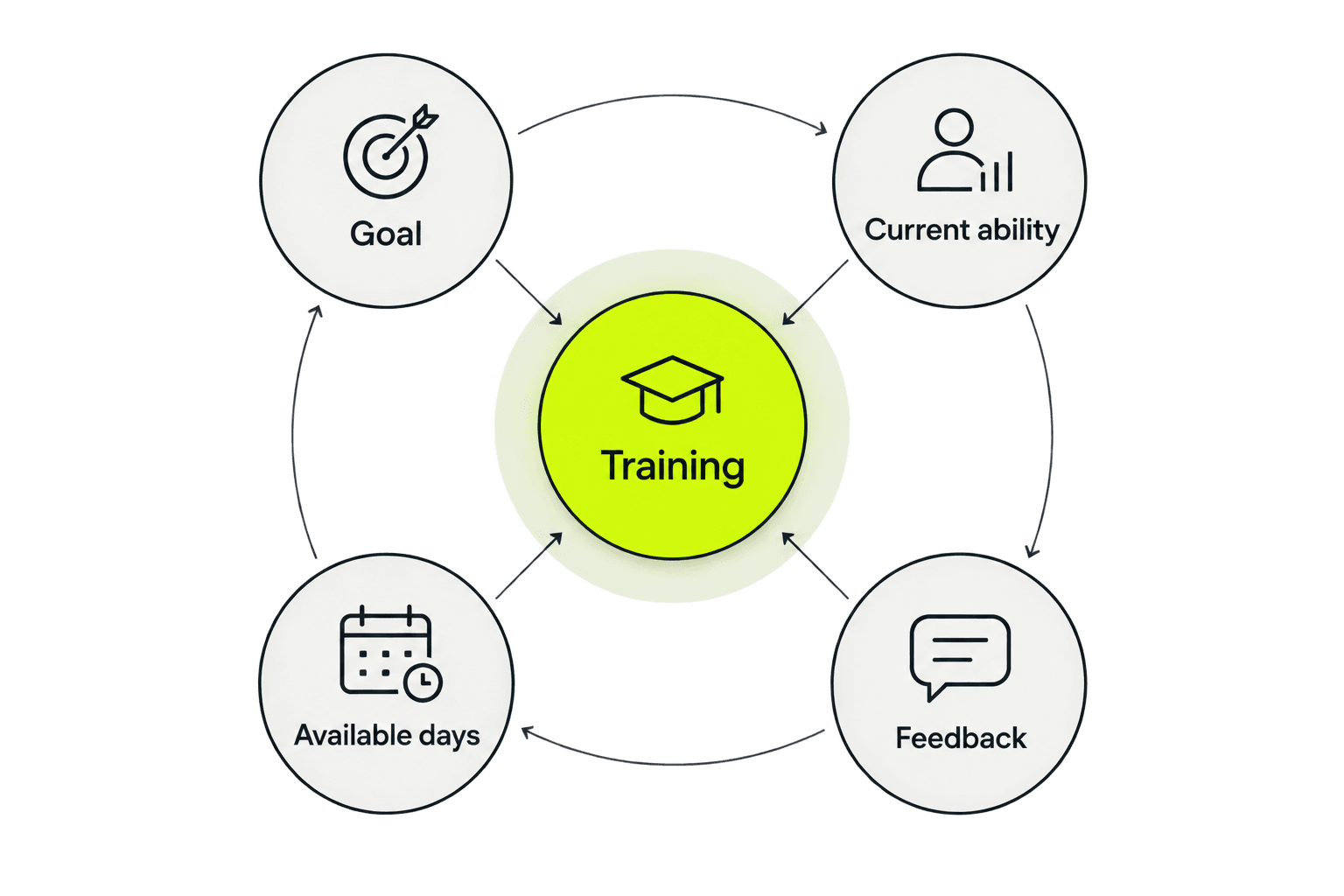
A personalized running plan should connect your goal, current ability, and available days to the sessions it assigns. You should be able to recognize those inputs in the opening schedule.
Use these questions to test that connection:
- Goal: Does the training address the distance you selected?
- Current ability: Does the opening week acknowledge your recent running and any break?
- Available days: Are sessions placed on days you can consistently use?
- Session length: Do weekday workouts fit the time you entered?
- Feedback: Is there a clear way to report that a workout was too hard?
You do not need access to the software's calculations. You do need instructions you can understand and a way to correct inaccurate assumptions.
Which plan format fits how you train?
Choose the format by the decisions you need help making. For a 2026 race, compare how each option handles your circumstances rather than choosing by the length of its feature list.
| Plan format | Best for | Advantage to look for | Limitation to check |
|---|---|---|---|
| Static training plan | Runners comfortable making their own schedule decisions | A clear outline you can read ahead | Changes require your judgment or separate guidance |
| Adaptive running app | Runners who want their training schedule updated | Adjustments that reflect the information you provide | Check which changes it supports and what feedback it needs |
| Human coach | Runners who want direct discussion about training decisions | Individual explanation and conversation | Check communication arrangements and the coach's scope |
Kiki is best for iPhone runners who want an adaptive personalized running plan. The app builds and adapts personal training plans, but that does not remove your responsibility to report your situation accurately or check whether a session fits your day.
A static plan is not automatically a poor choice. Its trade-off is straightforward: you take responsibility for interpreting changes rather than expecting the calendar to respond on its own.
Why personalized running plans vary
Two runners preparing for the same distance do not necessarily need the same starting schedule. Review these drivers before comparing weekly totals or workout names.
- Race goal. Finishing a first race and pursuing a time target create different planning questions.
- Recent running. Your current routine is more useful for reviewing the opening week than a distant personal best.
- Available days. A schedule must fit the days you can train, not simply divide sessions across the calendar.
- Available time. A workable long-run day does not solve weekday sessions that exceed your free time.
- Training feedback. A plan needs a response when the assigned effort repeatedly feels too hard.
- Schedule changes. Travel, changing shifts, and missed sessions require decisions about the remaining training.
Do not judge personalization by how complicated the calendar looks. Judge it by whether these differences are acknowledged and whether the instructions remain usable when an input changes.
Can you understand every workout before starting?
Read a representative easy session, a longer outing, and any harder workout included in the plan. Check the warm-up, main work, recovery instructions, and finish rather than reading only the headline duration.
For an easy run, you should understand the intended effort without having to chase an unexplained pace. Being able to talk comfortably is a useful practical check; the session should not turn into a test because a number appears on your watch.
For a harder workout, identify what separates the work from the recovery. If you cannot explain the session in plain language, clarify it before attempting it.
Watch for these instruction gaps:
- A pace target with no clear connection to your current running.
- An interval workout with unclear recovery instructions.
- A session duration that excludes additional work you must also complete.
- A run/walk workout that does not explain when to switch.
Clear instructions do not guarantee that a workout will feel right. They let you recognize when it does not and describe the problem accurately.
What should happen if you miss a run?
A missed run should trigger a review of the remaining week, not an automatic attempt to squeeze everything in. Check the plan's guidance before moving sessions together or adding missed work to another day.
Use how to adjust a personalized running plan after a missed run to think through the decision. Distinguish a scheduling problem from fatigue or discomfort; the reason you missed the session matters.
Test a hypothetical change before committing to your 2026 schedule. Ask what happens if your planned long-run day becomes unavailable, then look for an understandable answer rather than assuming every session must survive unchanged.
How do you know whether the opening week fits?
The opening week fits when its sessions reflect your recent running and fit the days and time you actually have. Completing it should not require rearranging your life around assumptions you never agreed to.
Before starting, explain the week aloud: when you will run, what each session asks, and which days have no running. If that explanation exposes a conflict, change the plan before the conflict becomes a missed workout.
After starting, compare the intended effort with what you experienced. One difficult day is information; repeated difficulty is a reason to reassess the workload and the inputs behind it.
When should you change the plan before starting?
Change the plan before starting when the opening week does not fit your current ability or available time. Do not use the first week to prove you can tolerate an obvious mismatch.
Pause and resolve the issue when:
- The plan assumes running days you cannot use.
- The opening sessions substantially exceed your recent routine without explanation.
- A time target appears without supporting information about your running.
- You cannot tell how to report fatigue or an overly hard session.
- The schedule leaves you guessing how to handle a known trip or work change.
Pain is a separate decision, not a calendar inconvenience. Stop a session that causes pain rather than treating completion as the priority, and seek qualified medical advice for persistent or concerning symptoms.
FAQ
What should I check first in a personalized running plan?
Check whether the opening week matches your recent running and actual availability. Confirm the race goal next, then read the effort and adjustment instructions before starting.
Is a personalized running plan better than a static plan?
A personalized running plan is a better fit when you want training shaped around your inputs and updated as circumstances change. A static plan suits runners who are comfortable making those decisions themselves; personalization alone does not establish that a plan fits.
Can I review a running plan without knowing my race pace?
You can review a running plan without knowing your race pace. Check your recent running, available days, session lengths, and whether the effort instructions make sense without an unsupported time target.
Should I accept a plan that starts harder than my current routine?
Resolve a clear mismatch before accepting a plan that starts harder than your current routine. Check the information you entered and ask how the opening workload was selected rather than treating difficulty as proof of quality.
Does Kiki work for runners preparing for a first marathon?
Kiki builds and adapts personal training plans for runners from beginners to marathoners on iPhone. A first-marathon runner should still review the starting workload, available training days, and race goal before beginning.
What should I do if something hurts during a planned run?
Stop the run rather than treating pain as a scheduling problem to solve. Seek qualified medical advice for persistent or concerning symptoms instead of relying on a training adjustment to explain them.
One last thing
Before accepting your 2026 plan, write down the first foreseeable disruption. It might be a late shift, a trip, or a weekend you already know is full.
Then check how you would handle it. A useful plan needs an understandable response to an ordinary bad week, not just an attractive perfect week. That check tells you something the race-day calendar cannot.


