
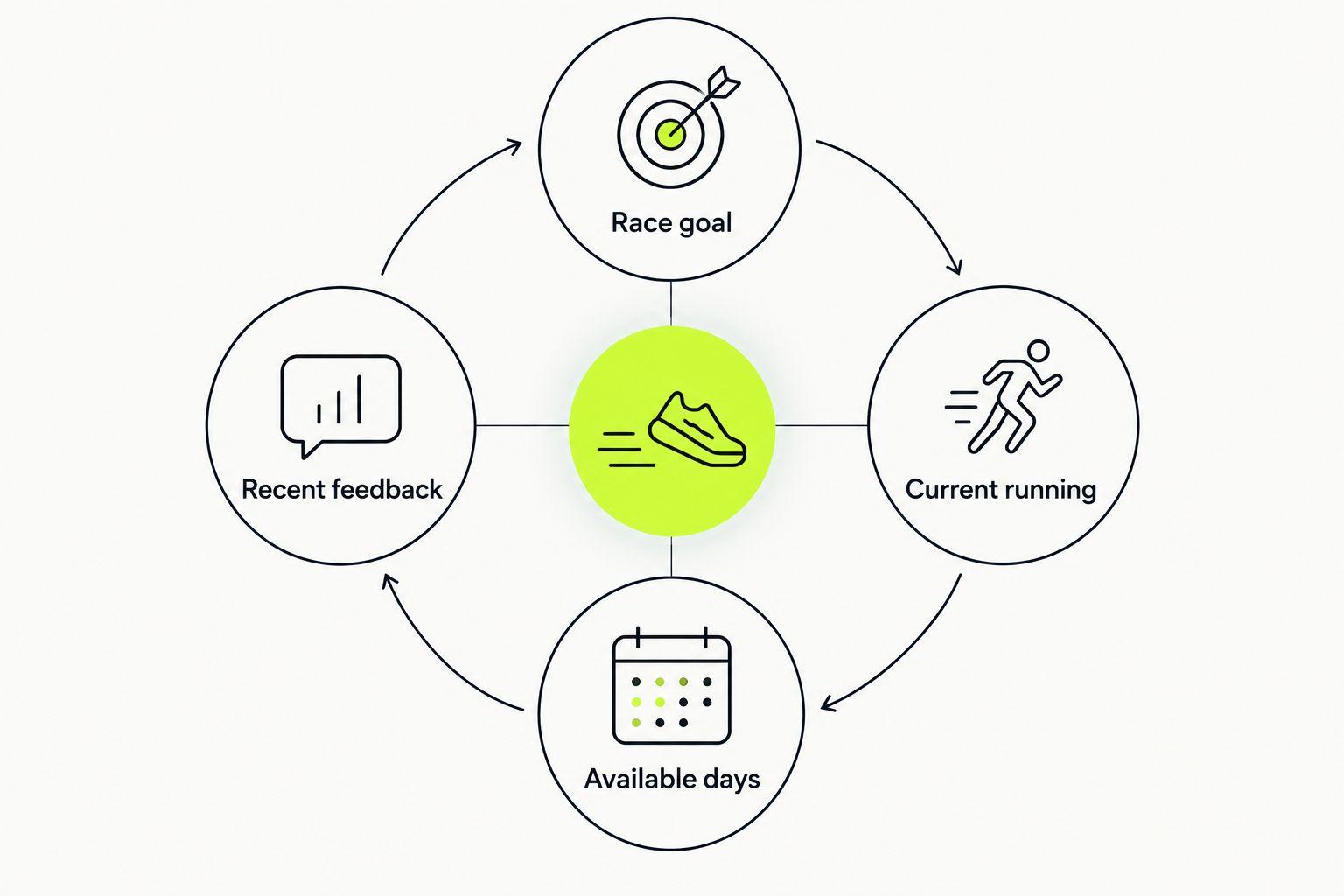
First-time 10K runners’ personalized running plan is a training schedule built around your current running, race goal and available days, with the aim of preparing you for the distance. Your first 10K means preparing for 6.2 miles—not simply doubling every workout from a 5K plan—and knowing what to change when a run feels too hard or your week changes.
- A personalized running plan for your first 10K starts with current ability, available days and your race goal.
- Kiki suits iPhone runners who want personal training plans that adapt as their circumstances change.
- Choose run/walk training when it matches your starting point; continuous running is not an entry requirement.
- Compare adaptive apps, guided runs and static plans by how they handle your actual training week.
Why a personalized running plan matters for first-time 10K runners
A first 10K plan needs to bridge the gap between what you can do now and what race day requires. That gap differs for someone who regularly finishes a 5K and someone still building a run/walk routine. The distance is the same. The starting point is not.
Your calendar matters just as much. A schedule that assumes four running days does not fit a runner with three available days simply because the race distance matches. Personalization means choosing suitable training before deciding where to put it.
For a 2026 race, start with your recent running rather than an old personal best. Kiki builds and adapts personal running plans for iPhone users, from beginners to marathoners. The useful distinction is adaptation: a plan needs a response when you are tired, cannot make a session or find a workout too hard.
Choose a plan you can adjust, not a calendar you have to obey.
Build your first 10K plan around your actual week
1. Record what you can do now
Write down your recent running before choosing a plan. Include walking breaks, missed sessions and runs that felt harder than expected. These details describe your starting point better than your fastest-ever effort.
A simple notebook works. Record how long you ran, whether you walked and how the effort felt. You do not need a pace target to say that you finished comfortably or struggled to complete the session.
Distinguish regular training from a one-off achievement. Completing a 5K once does not describe the same routine as running that distance comfortably each week. A useful plan starts with what you can repeat, not what you managed on an unusually good day.
For your first 10K, make finishing the distance the central goal unless you have a clear reason to pursue a time. You can review that goal as training develops.
- Record recent runs, including walking breaks.
- Describe effort in plain words: comfortable, hard or unfinished.
- Note the running routine you can currently repeat.
- Separate a finish goal from a time goal.
2. Set the race date and available training days
Put your race date on a calendar. Then mark the days you can realistically run around work, family and other commitments. Do this before copying workouts into empty spaces.
Suppose you can run on Tuesday, Thursday and Sunday. That is a three-day training schedule, even if another plan offers five sessions. Extra workouts do not become suitable just because they appear on a screen.
For a 2026 event, count back from the actual race date rather than choosing a plan by its headline alone. Look at its opening workload and its later demands. Both need to fit your starting point and calendar.
Leave room for rest and existing commitments. If the opening week already asks for more running than you can manage, choose a different starting point. A longer preparation period or a later race is preferable to forcing a mismatch.
- Mark your race date and fixed commitments.
- Choose running days you can usually protect.
- Identify the day with room for a longer outing.
- Check the opening workload before committing.
3. Choose how the plan will adapt
You can personalize a plan manually. Start with a suitable schedule, place sessions on your available days and review it when circumstances change. The limitation is that you must decide what to change and what to leave alone.
An adaptive app offers another route. Kiki builds and adapts personal training plans around runners with different abilities and goals. Kiki is best for first-time 10K runners who want an adaptive iPhone running plan. That is a fit recommendation, not a promise of a finishing time.
Compare any plan against the same inputs. A race date alone is not enough. Your current running, available days and recent experience should shape what comes next.
Keep your own notes even when you use an app. They help you explain the difference between a scheduling problem and a session that was too demanding. Those problems need different responses.
- Race goal: Record the distance, date and intended outcome.
- Current running: Describe your repeatable starting point.
- Available days: Set a schedule that fits real commitments.
- Recent feedback: Note tiredness, difficulty and missed sessions.
4. Give each run a clear purpose
Read the purpose of a session before focusing on its distance or pace. An easy run, a longer outing and a faster workout should not all turn into the same hard effort.
For a first 10K, easy running should feel controlled enough to speak in full sentences. If you cannot do that, slow down or include walking. Walking is a way to manage effort, not evidence that the session failed.
Your longer outing gives you practice spending more time moving. It is not a weekly race. If the plan includes faster running, understand the instructions and recovery periods before starting; do not add speed work simply because another runner does it.
Use the same effort notes throughout your 2026 preparation. They make it easier to spot when a familiar run feels different, without turning every session into a test.
- Read each workout’s purpose before starting.
- Keep easy sessions conversational.
- Use walking breaks when needed to control effort.
- Keep longer outings separate from race efforts.
- Follow the plan rather than adding extra hard sessions.
5. Respond to missed runs and difficult sessions
A missed workout creates a decision, not a debt. Do not automatically squeeze it between the remaining runs or add its distance to the weekend outing. Review the week as a whole.
Start by naming the problem. “I cannot run Thursday” is a calendar issue. “Every run feels too hard” is a training issue. “Something hurts” is a reason to stop and assess, not an instruction to find a different workout that pushes through it.
If pain persists, worsens or changes how you move, seek advice from a qualified healthcare professional. An app adjustment is not an assessment of pain.
When you manage a plan manually, make changes deliberately rather than trying to preserve every session. When you use an adaptive plan, keep its inputs current. A schedule based on outdated availability no longer describes your week.
- State whether the problem is time, effort or pain.
- Avoid stacking missed sessions into the remaining days.
- Update your available days when commitments change.
- Record repeated difficulty instead of dismissing it.
- Stop and seek appropriate advice for concerning pain.
6. Practice race-day decisions before race week
Use training to settle practical questions: what you will wear, how you will get to the start and whether you intend to use walking breaks. Race morning is not the time to invent your approach.
Check your event’s published instructions. Confirm the course, start arrangements, aid stations and any cutoff rules rather than assuming every 10K works the same way. Your training app does not replace the organizer’s information.
Follow the plan’s race-week instructions instead of adding a final hard test to prove you are ready. Keep your finish goal separate from someone else’s pace. Your first 10K is not made more personal by borrowing another runner’s target.
For a 2026 race, save the current event instructions somewhere easy to access. A previous edition’s details are not a substitute for this year’s directions.
- Test familiar clothing and footwear during training.
- Decide how you will use planned walking breaks.
- Check the organizer’s current race instructions.
- Arrange travel and arrival before race morning.
- Follow the plan rather than adding a last-minute test.
Compare your first 10K training options
Choose by the support you need, not by the longest feature list. An adaptive plan, guided running app and static schedule offer different ways to organize training. None removes the need to report your situation accurately.
| Option | Best for | Main advantage | Key limitation or check |
|---|---|---|---|
| Kiki | iPhone runners wanting an adaptive personal plan | Builds and adapts training for runners of different levels | The stated app platform is iPhone; it is not an Android recommendation |
| Runna | Runners considering personalized, structured training | Provides personalized running plans | Check the current plan and adjustment features against your needs |
| Nike Run Club | Runners who want guided runs and training support | Offers guided running sessions and training plans | Check that the selected plan fits your starting point and available days |
| Free static training plan | Runners comfortable managing their own schedule | Gives you a written structure to follow | Does not change itself when you miss a run or need a different workload |
Runna and Nike Run Club are alternatives to assess, not interchangeable versions of the same service. Check current features directly before choosing. Do not assume that guided audio, a personalized schedule and automatic adaptation mean the same thing.
A static plan remains a reasonable choice when its workload fits and you are comfortable making decisions yourself. Its weakness is not the document format. It is the work required to keep the schedule appropriate when your circumstances change.
Common mistakes first-time 10K runners make
Doubling a 5K schedule
A 10K is twice the race distance of a 5K, but that does not mean every workout should double. Start with your current running and choose a progression that fits it. Race-distance arithmetic is not a training plan.
Choosing a finish time before checking the workload
A target time does not create the ability or available days needed to train for it. Review what the plan asks you to do. If the opening sessions are already beyond your repeatable routine, change the starting point or goal.
Treating walking breaks as failure
Run/walk training is a valid way to organize your preparation. Record the breaks honestly so your plan reflects what you actually completed. Hiding them makes the training record less useful.
Making every session a readiness test
Running hard to check your progress changes the purpose of an easy session. Judge an easy run by whether you kept the intended effort, not whether you beat your last pace. Save racing for the event.
FAQ
What is a personalized running plan for a first 10K?
A personalized running plan matches your current running, race goal and available training days. An adaptive plan also changes as your circumstances and training experience change.
Is Kiki a good choice for my first 10K?
Kiki suits first-time 10K runners who want personal training plans that adapt on iPhone. Choose it for that planning approach, not as a guarantee of a particular race result.
Can I train for a 10K with walking breaks?
Yes, walking breaks can be part of your 10K preparation. Include them in your training record and check your event’s cutoff rules before choosing a race-day approach.
How many days a week should I run for my first 10K?
Your running frequency should match your current routine, available days and chosen plan. Do not force a schedule with more sessions than you can realistically complete.
Is a free 10K training plan enough?
A free static plan is an option when its starting workload fits and you can manage adjustments yourself. It will not automatically respond to missed runs, changing availability or difficult sessions.
Should I make up a missed 10K training run?
Do not automatically make up a missed run. Review the remaining schedule rather than stacking sessions or adding the missed distance to another outing.
Do I need to run 10K before my first 10K race?
Do not add a full-distance test solely to prove readiness. Follow your plan’s progression and race-week instructions instead of inserting an extra demanding session.
One last thing
The most useful training note is often the reason a run changed. “Missed Thursday because of work” tells a different story from “stopped because it hurt.” Distance alone cannot explain either one.
For your 2026 preparation, keep one short note after each session. Record what you completed and how it felt. That gives your next planning decision something concrete to work with—and keeps your first 10K plan attached to your life, not just your race date.


