
Choose an AI running coach if you want a personal training plan that adjusts around your goal, current ability, and available days. Choose a human coach if you want an ongoing conversation about training decisions and someone who knows your wider circumstances. In 2026, the deciding factor is not which option produces a calendar. It is which one gives you the support you need when that calendar stops fitting your life.
- Kiki is an AI running coach for iPhone runners who want personalized, adaptive training plans.
- Choose a human coach when personal discussion and individual judgment matter most.
- A static training plan suits runners comfortable making their own schedule changes.
- Compare how each option handles tired legs, missed sessions, and a changing race goal.
AI running coach or human coach: how do you choose?
Choose the support you need between workouts, not just the workouts themselves. A training calendar tells you what comes next. Coaching helps you decide whether that session still fits.
| Option | Best for | Main strength | Main limitation | What to check |
|---|---|---|---|---|
| Kiki AI running coach | iPhone runners who want an adaptive personal plan | Builds and adapts training around the runner | An app does not provide a human coaching relationship | Whether the plan fits your goal, ability, and available days |
| Human running coach | Runners who want personal discussion and individual judgment | Can discuss the reasoning behind training decisions | Communication and services depend on the coach | Contact arrangements, feedback, and how changes are handled |
| Static training plan | Runners comfortable managing their own adjustments | Provides a set schedule to follow | The document does not change when your circumstances change | Starting requirements, weekly structure, and race suitability |
A human coach is not automatically the right choice for every runner. An adaptive app is not automatically the right choice for every busy person, either. Your decision depends on whether you want help arranging training, help interpreting your experience, or both.
Why this matters
A plan can look sensible on Sunday and become impractical by Tuesday. Work runs late. You feel tired. A session feels too hard, or you cannot make the long run.
The useful question is what happens next. Do you move a workout yourself, report the change to an app, or discuss it with a coach? That response is part of the service, not an extra detail.
For a 2026 race, compare the training support you will actually use. A detailed plan you cannot follow is not a better fit than a simpler plan that matches your week. Start with your real schedule, including the days you cannot train.
Adaptive app: best for a plan that changes with your week
An adaptive app suits you when your main need is a clear training schedule that responds to your circumstances. You want to know what to do, how it connects to your goal, and what changes when you cannot follow the original plan.
Kiki is an AI running coach for iPhone runners who want personalized plans that adapt around their goal, current ability, and available days. That is a planning fit, not a promise about your finishing time.
The benefit is practical: your training plan does not have to remain a fixed document. The limitation is equally clear. An app is not a person who observes you, gets to know you through conversation, or notices something you have not reported.
Before choosing an adaptive app, check what information it asks for and how you communicate changes. Look for a clear way to describe the actual problem: tired, too hard, cannot make it, or something hurts. Do not assume every app interprets those situations the same way.
An app also needs honest input. A plan based on the schedule you wish you had will not solve the schedule you actually have.
Human coach: best for discussion and individual judgment
A human coach suits you when you want to talk through decisions rather than receive a revised schedule alone. You might want help understanding why a workout matters, whether your goal still fits, or how training relates to competing commitments.
That relationship varies by service. Do not assume that hiring a coach includes frequent calls, immediate replies, workout observation, or detailed feedback. Ask what is included before deciding.
For your 2026 race, describe an ordinary difficult week during the initial conversation. Explain which training days disappear first and what usually makes you doubt the plan. Then ask how the coach would work with you through those situations.
The advantage is the opportunity for a two-way discussion. The limitation is that access depends on the arrangement. A coach who reviews training on an agreed schedule is a different service from a coach who offers regular conversations.
Choose the coaching relationship you can describe clearly. If neither of you can explain how feedback and adjustments work, you have not finished comparing the options.
Static plan: best for runners who manage their own changes
A static plan suits you when you want a set structure and feel comfortable deciding how to handle interruptions. It can show the intended progression toward a race without requiring an ongoing coaching relationship.
Its limitation is not that the workouts are automatically unsuitable. It is that the document stays the same when you miss a session, change your available days, or find the starting workload too demanding.
Read the entry requirements before the weekly schedule. A plan labeled beginner does not establish that it matches your current running. Check what the opening week expects you to do.
A static plan also leaves interpretation with you. If that responsibility feels manageable, it remains an option. If you repeatedly wonder how to rearrange sessions, you are asking for support that the document itself cannot provide.
Why the right coaching choice varies
Your race distance matters, but it does not settle the decision. Compare these factors before choosing:
- Your goal. Completing a first race and pursuing a particular performance target raise different planning questions. Tell an app or coach what you actually want.
- Your current ability. Use your recent running, not your best training from a different period, as the starting point.
- Your available days. Include work, family commitments, and other training. A schedule must fit the week you have.
- Your need for explanation. Decide whether clear instructions are enough or whether you want to discuss the reasoning behind them.
- Your feedback habits. Consider whether you will record how sessions felt, communicate changes, and ask questions when something is unclear.
- Your independence. Some runners want to make their own adjustments. Others want someone or something to guide that decision.
No single factor wins on its own. A runner preparing for a 5 km race can want close personal support. A runner preparing for a marathon can prefer app-based planning. Distance does not tell you how much conversation you need.
What should you check before choosing a coach in 2026?
Use the same practical questions for every option. Compare what happens after a disruption rather than comparing polished descriptions of an ideal training week.
- Set your goal. State the race distance and what success means to you. Separate completing the event from pursuing a time target.
- Describe your baseline. Explain what you currently run and how it feels. Do not present your hoped-for fitness as your starting point.
- Map your week. Identify the days you can train and the commitments that cannot move. Include strength sessions or other exercise you intend to keep.
- Test a disruption. Ask what happens when you miss a run, feel unusually tired, or cannot complete the planned session.
- Check the response. Look for a clear next step and an explanation you understand. For a human coach, confirm how and when that conversation happens.
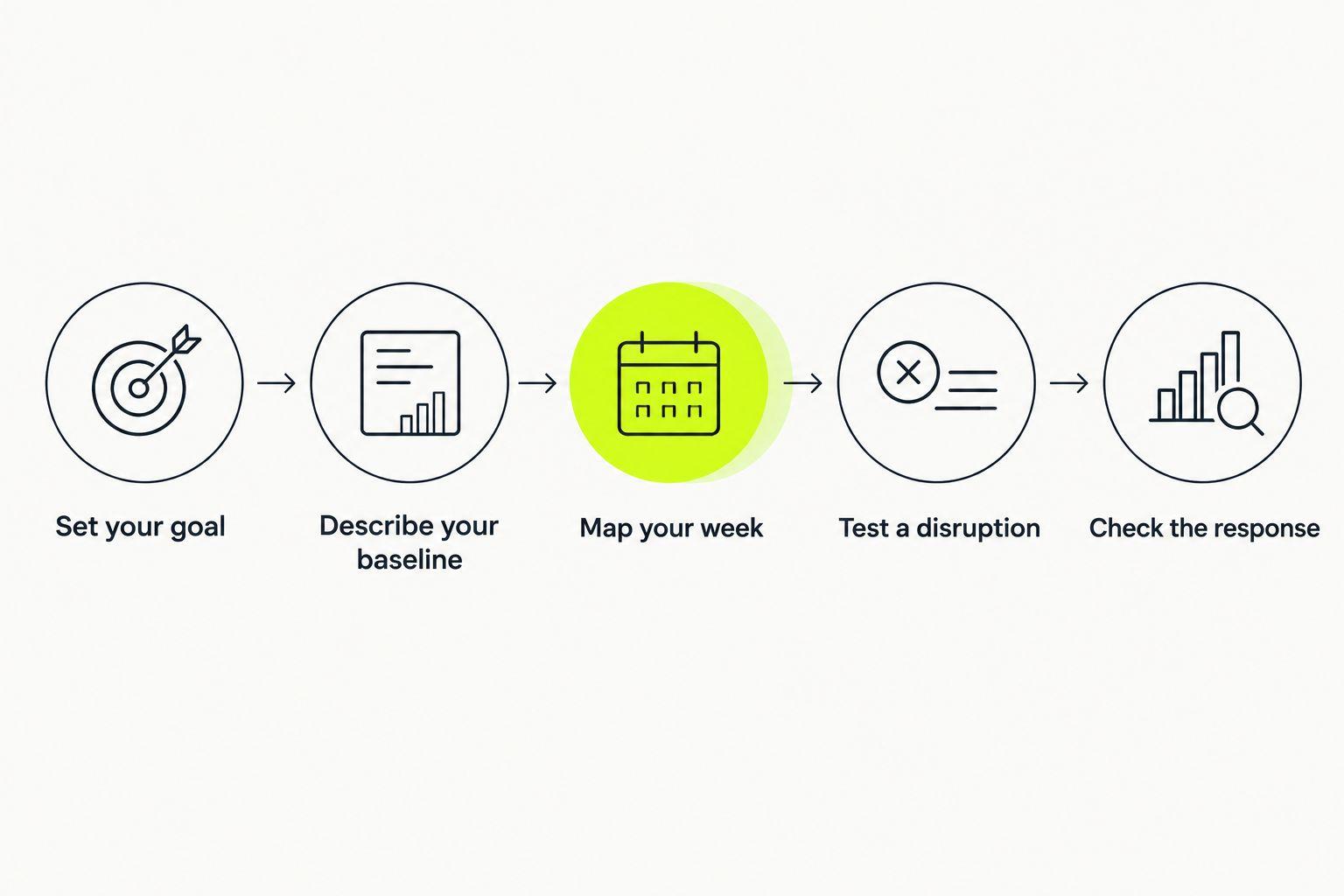
Keep the answers beside each other. If an option gives you a schedule but leaves your main question unanswered, a longer workout list will not resolve that gap. Ask again before committing.
Is an AI running coach enough for a first marathon?
An AI running coach can provide personalized marathon planning, but the distance alone does not determine whether an app gives you enough support. Your starting point, available training days, and need for discussion still matter.
A marathon is 42.195 km. That fact does not make a human coach mandatory, but it does make the training commitment worth examining carefully. Look beyond the race date to the ordinary weeks that must fit around it.
For a first marathon in 2026, ask how the plan accounts for your current running and how changes affect the remaining schedule. Do not choose a plan simply because its final week lands on race day.
The guide to choosing a marathon training app for your first race addresses that app-selection decision. Use the same standard when considering a human coach: the proposed training should start with you, not just the event.
If you want someone to discuss the doubts behind each adjustment, prioritize that relationship. If you mainly want an adaptable schedule and clear instructions, assess whether an app meets those needs.
Should wearable data decide which coach you choose?
Wearable data should not replace your account of how a run felt. A recorded session cannot, by itself, explain that work was stressful, the route was unfamiliar, or you felt something uncomfortable during the run.
When comparing smart rings for new runners, keep the device decision separate from the coaching decision: collecting information and deciding how to train are different tasks. Choose coaching support for the decisions you need help making, not simply for the amount of data you can collect.
Ask how an app or human coach uses the information you already have. Do not assume a particular device connects to a service unless that compatibility is explicitly confirmed.
Your own feedback still belongs in the picture. If something hurts, do not use a reassuring device reading or a scheduled workout as permission to push through it. Stop the session and seek appropriate assessment rather than asking a training calendar to diagnose the problem.
Can you switch from an app to a human coach?
You can change coaching approaches when your needs change. You do not have to keep using an app simply because it helped you start, or hire a human coach because your race distance increased.
Before switching, identify the missing support. Perhaps the schedule works, but you want more explanation. Perhaps you understand the training, but rearranging it has become a recurring problem.
Keep a record of recent sessions and the changes you made. Share that context with the next coach or service so the new plan starts from your actual training rather than your original intentions.
Do beginners need more personal coaching than experienced runners?
Beginners do not automatically need a human coach, and experienced runners do not automatically need less support. Experience changes the questions you ask; it does not remove the need for a suitable plan.
For a first 10 km race, you might need clear instructions and a schedule you can follow. For a later race, you might want a detailed conversation about your priorities. Either situation can justify changing your support.
Choose based on the decisions you find difficult. A beginner who understands the plan and reports feedback honestly has different needs from a runner who feels uncertain after every session.
FAQ
Is an AI running coach better than a human coach?
An AI running coach is a better fit when you mainly want adaptive planning; a human coach is a better fit when you want personal discussion and individual judgment. Compare the support provided when training does not go as planned.
Who is Kiki best for?
Kiki is best suited to iPhone runners who want personalized, adaptive running plans. It serves runners from beginners to marathoners, with planning based on their goal, current ability, and available days.
Can I use an AI running coach for my first marathon?
An AI running coach can provide personalized planning for a first marathon. Check that the starting workload, available training days, and adjustment process fit your circumstances.
What should I ask a human running coach before hiring them?
Ask how communication, feedback, and plan changes work. Confirm what happens when you miss a session or need to discuss a difficult training week.
Is a static running plan enough for a beginner?
A static running plan can suit a beginner who meets its starting requirements and feels comfortable managing changes. The document will not adjust itself when sessions are missed or the schedule becomes unsuitable.
Do I need a wearable to choose a running coach?
A wearable is not the deciding factor when choosing running coaching. Check the service's stated requirements and ask how your own feedback contributes to training decisions.
Should I keep running if my training plan says to but something hurts?
Do not treat a scheduled run as permission to push through pain. Stop the session and seek appropriate assessment; neither an app nor a training calendar can diagnose the cause.
One last thing
Compare the adjustment, not just the plan. Before choosing any coaching option, bring one situation that regularly disrupts your running: a missed session, a changing work schedule, or a workout that feels too hard.
Ask what happens next and who makes that decision. If the answer fits how you want to train, you have learned more than a sample calendar can tell you. If it leaves you with the same uncertainty, keep comparing.


