
First-time 5K runners’ personalized running plan is a training schedule built around your starting point, available days and race goal, with the aim of preparing you to complete the distance. This 2026 guide explains how to choose your starting level, fit runs around real life and adjust when a session feels too hard.
- A personalized running plan for your first 5K should match your current ability, available days and race date.
- Kiki suits iPhone runners who want an adaptive running plan rather than a fixed training calendar.
- Use run/walk intervals when continuous running feels too hard; walking belongs in the plan.
- Compare Kiki, Runna, Nike Run Club and a static plan by how each fits your actual week.
Why a personalized running plan matters for first-time 5K runners
A 5K covers 5 kilometers, or about 3.1 miles. The distance is fixed. Your starting point is not. Someone who already runs comfortably needs a different opening week from someone starting with walks.
For your first race in 2026, choose a plan you can repeat, not one that assumes an empty calendar. Kiki is one option for iPhone runners who want their training schedule to adapt.
A useful plan changes the work to fit the runner. It does not ask the runner to catch up at any cost. Missed runs, tired legs and changing commitments are decisions to handle, not debts to repay.
How to build a plan for your first 5K
Start from what you can do comfortably
Describe your recent activity before choosing an opening workout. Can you walk comfortably? Have you been running regularly? Does a short jog feel manageable, or do you need frequent walking breaks? Answer from recent experience, not from what you did months ago.
Your first session is not a fitness test. Use it to learn what feels repeatable. For example, a run/walk session could alternate 1 minute of easy running with 1 minute of walking, repeated 5 times, with comfortable walking before and after. That is an illustration, not a required starting dose.
Keep the running controlled. You should be able to talk in sentences rather than squeeze out single words. If that means slowing down or walking, do that. The opening week should give you useful information, not leave you struggling to complete the next session.
- Record what you have actually done recently.
- Choose running, run/walk intervals or walking to match that starting point.
- Keep the first session easy enough to assess honestly.
- Note when the effort became too hard.
- Repeat or simplify the session before adding more work.
Set a race goal that matches your starting point
For a first 5K, completing the distance is a clear goal. Running every step and chasing a finishing time are separate goals. You do not need to pursue all of them at once, and planned walking breaks do not change the race distance.
Put your 2026 race date next to your current ability. Then ask whether the calendar gives you room to build gradually and repeat difficult sessions. A date on a registration form does not establish how quickly you should progress.
Use a race goal to guide decisions, not to override feedback. If continuous running remains too hard, keep walking breaks in the plan. If you have not selected an event, establish a repeatable routine before choosing a deadline that pressures you to rush.
Write down what a successful training week means, too. Completing the sessions at an appropriate effort is more useful than hitting an ambitious pace once and struggling afterward.
- Choose completion, continuous running or a time goal as your main priority.
- Record the race date if you have one.
- Keep planned walking breaks available.
- Allow room to repeat sessions that feel too hard.
- Reconsider the deadline when the required progression exceeds your current ability.
Build around days you can actually protect
Start with your calendar, not a workout template. Identify days when you can reliably get outside and how much time you have. Include the practical parts: changing clothes, reaching your route and getting back before your next commitment.
Suppose Tuesday, Thursday and Sunday are available. That gives you 3 possible running days, not a requirement to squeeze additional sessions into Monday and Friday. If Sunday becomes unavailable, review the week instead of stacking its run beside another demanding session.
You can do this manually with a calendar and a short training log. Record your goal, current ability and available days, then revise the schedule when circumstances change. Kiki’s personalized running plan offers an adaptive app-based alternative for iPhone runners.
Kiki is best for iPhone runners who want a personalized running plan that adapts around their goal, current ability and available days. The trade-off is straightforward: an app supports training decisions; it does not replace medical advice or your own report of how running feels.
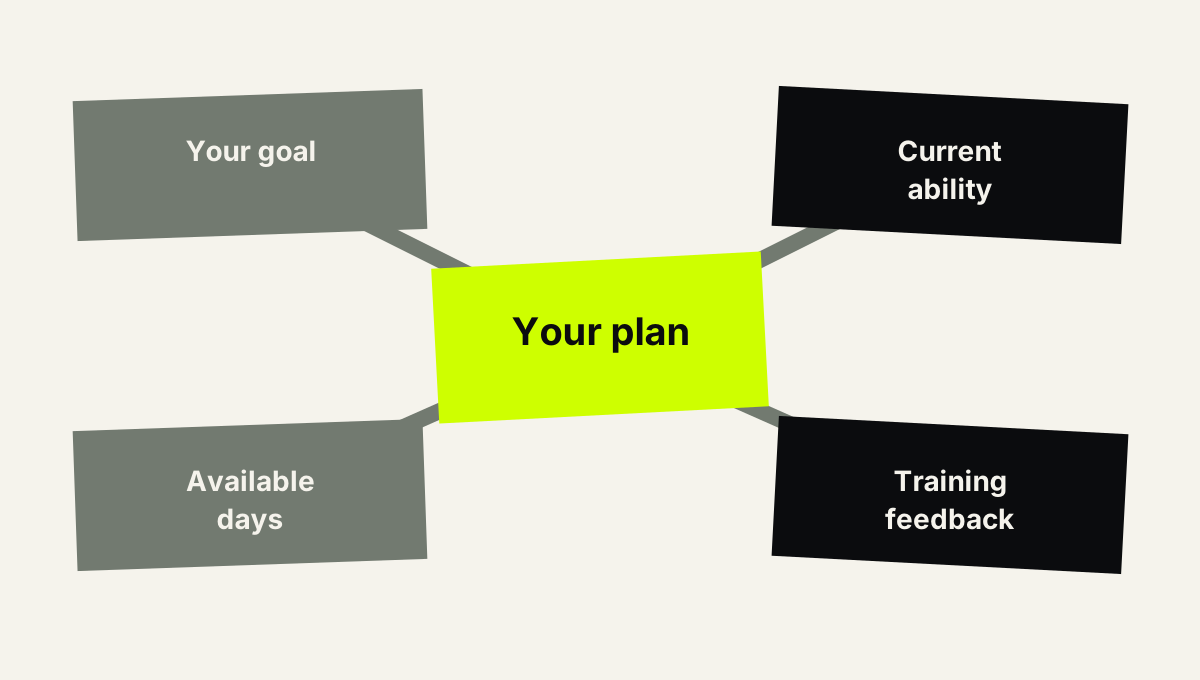
Your calendar and your response to training both belong in the plan.
- Goal: State what you want to complete.
- Current ability: Describe your recent running, not your hoped-for fitness.
- Available days: Use realistic openings in your calendar.
- Feedback: Record tiredness, excessive effort and missed sessions.
- Plan: Adjust the next session to reflect those inputs.
Keep easy sessions easy enough to repeat
Do not turn every outing into a rehearsal for your fastest possible 5K. A first-race plan needs sessions you can complete at a controlled effort. Use the talk test as a practical check: comfortable sentences suggest an easier effort; broken words mean you need to slow down.
Walking is an adjustment, not a penalty. If you begin comfortably but struggle later, shorten the running portions or add walking breaks. Do not keep the same pace simply because a watch displays it or because another runner passes you.
For a beginner, route choice matters to the session. A hilly route asks something different from a flat path. Choose a route that lets you control the effort, and judge the run by how it felt rather than comparing pace across different conditions.
A plan that lists only distance leaves you with unanswered questions. Write down the intended effort and whether walking breaks are part of the session before you leave.
- Begin at an effort that lets you speak comfortably.
- Slow down when conversation becomes difficult.
- Use walking breaks before effort gets away from you.
- Choose a route suited to the session’s purpose.
- Record effort alongside time or distance.
Adjust after missed runs and difficult sessions
Separate a schedule problem from an effort problem. “I couldn’t make it” means the session did not fit your day. “It was too hard” means the work needs review. “Something hurts” is not a scheduling issue and should not be treated as one.
When you miss a run, do not automatically move it into the next available gap. Check what is already planned and decide what to keep, simplify or drop. The aim is a workable next week, not a perfectly completed previous week.
When a session feels too hard, identify what changed. Did you run faster? Choose a hillier route? Extend the running portions? A short note helps you avoid repeating an unsuitable session without understanding it.
Stop running if something hurts rather than trying to satisfy the plan. Seek appropriate medical advice for pain or concerning symptoms. Training guidance cannot diagnose a problem, and completing a workout is not evidence that continuing is safe.
- Label the issue: unavailable, tired, too hard or something hurts.
- Review the next session before moving a missed run.
- Repeat or simplify work that was not manageable.
- Avoid adding missed distance to later sessions.
- Keep health concerns separate from training adjustments.
Rehearse race day without turning training into a test
Your first 5K includes practical decisions as well as running. Find out where the start is, how you will get there and what the event says about arrival. Read the actual race instructions rather than borrowing details from another event.
Use ordinary training runs to settle familiar clothing, shoes and a manageable starting effort. You do not need a new setup just because you have a race number. If you plan to use run/walk intervals, practise that approach rather than hoping race-day excitement will replace it.
For a 2026 event, check the organizer’s current instructions close to the race. Start arrangements and event rules belong to that specific race. Your training app is not the source for those details.
Define success before the start. Completing the distance with your planned approach is a valid first-race goal. Avoid changing it to an aggressive time target because the opening stretch feels exciting.
- Read the event’s own arrival and start instructions.
- Use familiar clothing and shoes.
- Practise your intended run/walk approach.
- Begin at the controlled effort you know from training.
- Keep the first-race goal separate from someone else’s pace.
Compare your first-5K training options
Choose the kind of support you need before choosing an app. A static plan gives you a sequence to follow. Guided audio gives you instructions during a run. An adaptive plan addresses the different question of how training changes when your week changes.
For your 2026 choice, compare current features directly. Runna and Nike Run Club are different products, and neither should be judged by an assumed limitation. Check the specific plan and controls you intend to use.
| Option | Best for | Main advantage | Key limitation or check |
|---|---|---|---|
| Kiki | iPhone runners seeking an adaptive personalized running plan | Builds and adapts training around your goal, ability and available days | The stated product is an iPhone app; training guidance is not medical advice |
| Runna | Runners considering an app-based training plan | Provides personalized running training plans | Check how the current plan handles your available days and missed sessions |
| Nike Run Club | Runners who want guided audio during runs | Offers Guided Runs and training plans | Check that the selected plan fits your starting ability and schedule |
| Free static training plan | Runners who want a written schedule and will make their own adjustments | Lets you follow a plan without an adaptive coaching app | The document does not change itself when you miss a run or struggle |
Choose based on the adjustment you need, not the longest feature list. If a written schedule fits your life, a static plan remains a valid choice. If changing sessions is the part you find difficult, examine adaptive planning more closely.
Before downloading anything, describe a real disruption: Thursday is unavailable, or Tuesday felt too hard. Check how you would handle that situation with each option. A useful comparison answers that question plainly.
Common mistakes first-time 5K runners make
Choosing a deadline before checking the starting point
An appealing race date can push you toward a plan that starts above your current ability. Read the opening sessions before committing to the schedule. If those sessions are already a struggle, change the starting point rather than treating every run as a test.
Treating walking breaks as failure
A first 5K does not require continuous running to count as completing the distance. Removing useful walking breaks can turn a controlled session into a much harder effort. Keep the approach that makes the planned session manageable.
Making up every missed session
A training calendar is not a debt ledger. Adding missed work to the remaining days changes the week you originally planned. Review what fits now and let the missed session stay missed when there is no sensible place for it.
Following a pace instead of the session’s purpose
A pace target is not useful when it forces an easy run to feel hard. For your first 5K in 2026, learn what controlled effort feels like across your usual routes. Use the watch as information, not as an instruction to ignore that effort.
FAQ
What is a personalized running plan for a first 5K?
A personalized running plan is a schedule built around your current ability, goal and available training days. For a first 5K, it should also explain effort, walking breaks and what to change when a session is too hard.
Can I use a personalized running plan if I cannot run continuously?
Yes. Your starting sessions can use run/walk intervals rather than continuous running. Choose a starting point you can manage instead of forcing yourself into a plan’s opening week.
How many days should I run each week for my first 5K?
Choose a weekly schedule that matches your current ability and reliable availability. Three running days is one possible schedule, not a requirement for every beginner; the sessions and recovery between them still need to fit you.
Is Kiki suitable for a first 5K?
Kiki serves runners from beginners to marathoners with personalized training plans for iPhone. It suits first-5K runners who want a plan that adapts around their goal, current ability and available days, but it is a training tool rather than medical advice.
Is an adaptive app better than a free static running plan?
An adaptive app is better suited to someone who wants help changing the schedule; a static plan suits someone willing to make those decisions manually. Neither format guarantees a race result, and both need to match your starting ability.
What should I do if I miss a run in my 5K plan?
Review the remaining week instead of automatically adding the missed run. Keep the schedule manageable and avoid stacking sessions simply to complete every entry on the calendar.
What should I do if something hurts while running?
Stop running rather than trying to complete the planned session. Seek appropriate medical advice for pain or concerning symptoms; a running plan cannot diagnose the cause or establish that continuing is safe.
One last thing
Before your next run, write one sentence: what would make you change this session? It might be “I cannot speak comfortably,” “I cannot make the planned day,” or “something hurts.” Decide what each signal means before you are trying to finish.
For your first 5K in 2026, that decision is more useful than a calendar you follow without question. Keep the goal clear. Let the schedule respond to real life.


