
Yes. A marathon training app can include strength training days, but a calendar entry is not the same as a strength workout that fits your running load. Choose a plan that makes room for lifting without treating your long run, recovery and available training days as separate problems.
- Marathon training app strength training should fit around your long run, recovery and available days.
- Kiki suits iPhone runners who want personalized running plans that adapt around their schedule.
- Check whether strength support means calendar slots, exercise instructions or adjustments to the whole training week.
- An integrated schedule is easier to assess than separate running and lifting plans that ignore each other.
Can a marathon training app include strength training days?
Yes, but check what the app actually schedules and explains. For your 2026 app shortlist, distinguish between reserving time for strength and receiving a coordinated running-and-strength plan. These are different levels of support.
Kiki builds and adapts personalized running plans for iPhone. If strength training is part of your week, check how your chosen app accounts for it before you commit to the schedule.
| Planning approach | Best for | Main advantage | Main limitation to check |
|---|---|---|---|
| Integrated running-and-strength schedule | Runners wanting one coordinated week | Shows running and strength together | A shared calendar does not prove the sessions are coordinated |
| Running app plus a separate strength plan | Runners who already have suitable strength guidance | Keeps an existing lifting routine in view | You must reconcile conflicting sessions |
| Static running plan with added strength days | Runners comfortable managing their own schedule | Makes the planned running progression visible | The document does not revise itself when your week changes |
None of these approaches removes the need to review how you feel. A tidy calendar can still contain more work than you can recover from.
Why this matters
Your training week has a fixed amount of time. Adding strength without changing anything else creates more training, not more recovery. That matters when you are already learning how to handle a first marathon build.
The useful question is not simply whether an app has a strength tab. It is whether the resulting week is workable for you. Pick the schedule you can follow, not the one with the most sessions.
For a first marathon in 2026, start with your current running ability and actual availability. Your race goal belongs in the plan, but so do work, family commitments and the days you cannot train. The broader marathon training app selection guide explains how to assess that fit.
What should strength support actually include?
A strength entry should tell you what to do, where it fits and what to change when the week becomes too demanding. Otherwise, you still have to build the combined plan yourself.
Use this checklist while reviewing an app in 2026:
- Calendar placement: Can you see strength sessions beside your runs, including the long run?
- Workout instructions: Does the session explain the exercises and how to perform the planned work?
- Effort guidance: Can you tell whether the session is intended to be demanding or light?
- Schedule changes: What happens when you move, shorten or miss a strength session?
- Feedback: Can you report that your legs feel tired or that the previous session was too hard?
- Scope: Is strength actually programmed, or are you only adding a reminder?
An exercise library answers what you can do. A training schedule answers when to do it. Coordinated guidance also addresses what happens to the rest of the week.
Do not treat those features as interchangeable. If you already work with a qualified strength coach, a calendar slot might be enough. If you need exercise selection and instructions, a reminder alone does not meet that need.
How do you fit strength around marathon training?
Build the week from your constraints before adding sessions. The following process is a planning check, not a prescribed training program.
Start with availability
Write down the days you can realistically train. Separate a short window before work from a longer weekend window. They are not interchangeable just because both appear as empty spaces on a calendar.
If you have 4 training days available, do not choose a schedule that quietly requires 6 separate visits to the gym or running route. Some activities might share a day, but that still requires enough time and manageable effort.
Protect key runs
Identify the runs that matter to your current plan, including the long run. Then inspect the strength work around them. A demanding leg session immediately before an important run deserves scrutiny, especially if you already know it leaves you tired.
Do not assume every run needs to feel hard to count. Strength sessions also contribute to the work your legs must recover from.
Place strength
Put strength into the calendar before declaring the running schedule finished. That exposes conflicts while you can still change the week.
For example, a week containing 3 runs and 2 strength sessions contains 5 sessions. If your availability is only 4 days, at least one day must contain both activities, or the schedule needs to change. That is calendar arithmetic, not a recommendation to train that often.
Review recovery
Look at how you feel after the combined schedule, not just after individual workouts. If lifting repeatedly makes the next run unmanageable, change the arrangement or workload rather than repeatedly forcing the same sequence.
Tell the app what happened using plain language: tired, too hard, cannot make it. If something hurts, stop the exercise that brings it on; do not use an automated schedule change as a diagnosis.
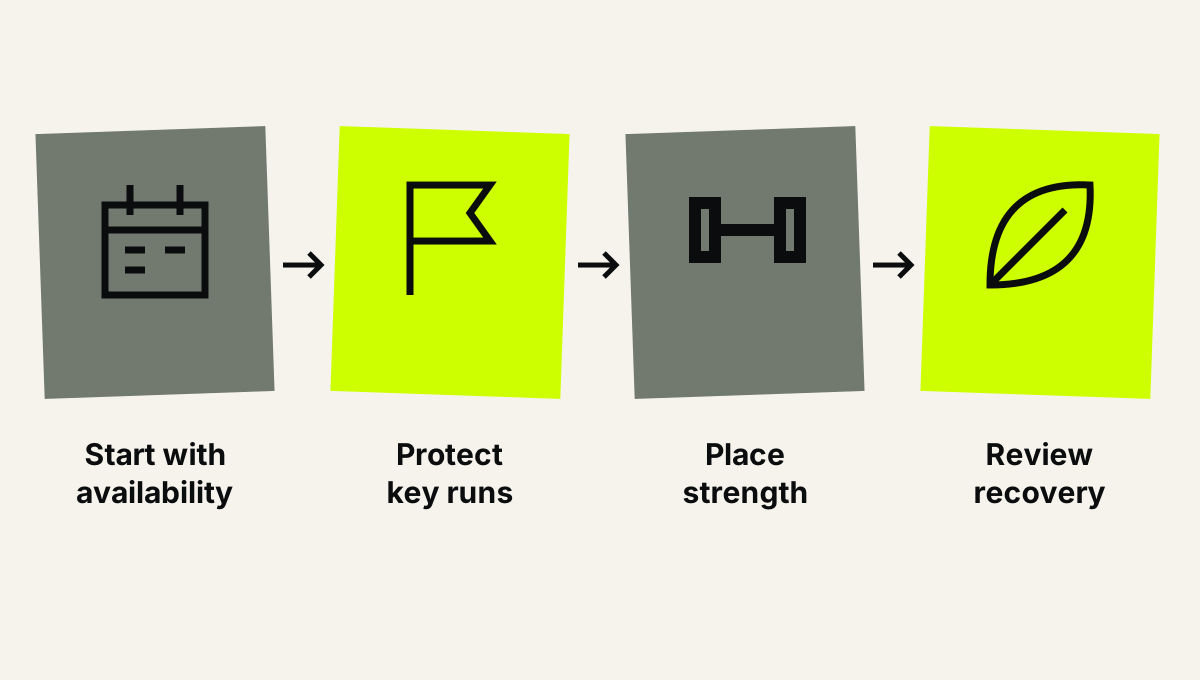
Place strength before you treat the weekly running schedule as finished.
The finished week should make sense without an explanation from the app. You should know which days require more time, where rest fits and what to reconsider if a session goes badly.
Why strength scheduling varies between runners
There is no single arrangement that fits every marathon runner. These factors change what a workable schedule looks like:
- Current running ability: A new runner and an experienced marathoner start from different workloads. Use your present ability, not an imagined future version of yourself.
- Available days: A schedule spread across the week creates different practical choices from one concentrated into a few days.
- Existing strength routine: Keeping familiar exercises is a different task from learning a new lifting routine during marathon preparation.
- Response to sessions: Your next run provides useful feedback about whether the previous strength session fitted the week.
- Race preparation: Strength needs to fit the running plan as the race approaches, rather than remaining an unrelated obligation.
- Equipment and access: A home session and a gym session place different demands on your time and setup.
Use these factors to assess personalization. Entering your race date is only part of the job. The plan also needs to reflect the time and training you can manage now.
Can you do marathon strength training at home?
Home strength training is an option when the planned exercises suit your equipment, space and experience. The important distinction is between following a suitable session and improvising one because you happen to own some weights.
Start with the exercise requirements. Check that you understand the movement, can set it up safely and have enough room. If the instructions are unclear, get help with the exercise rather than guessing from its name.
Equipment should follow the plan, not determine it. Comparing adjustable dumbbells for home workouts is a separate decision from deciding which strength exercises belong in your marathon week; neither decision replaces the other.
For your 2026 training setup, check practical friction as carefully as workout features. A home session only saves a trip if you can actually complete the prescribed work there. A gym session only fits the calendar if you include travel and setup time.
Keep the first question simple: can you carry out this session as written? If not, use an appropriate alternative supplied by your coach or training guidance. Do not assume every exercise substitution has the same demands.
How should you compare an adaptive app with other options?
Compare the training week each option produces, not the length of its feature list. Use the same race goal, current ability, available days and existing strength commitments for each assessment.
Kiki is best for iPhone runners who want personalized running plans that adapt around their schedule. That running-plan fit does not remove the need to check the strength guidance you require.
If Runna or Nike Run Club is on your shortlist, ask the same questions you ask of any app. Inspect the current experience for your device and chosen plan. Do not assume either includes a particular strength feature because a review mentions it without showing the relevant workflow.
A static running plan is also a valid option if you are comfortable managing changes yourself. Its trade-off is clear: the written schedule stays the same unless you edit it. You must decide how strength, missed runs and tired legs affect the week.
Use a concrete scenario when comparing options: your usual strength day becomes unavailable, and the next day contains an important run. Can you see what changes, what stays and what requires your judgment? That question reveals more than a general promise of personalization.
Choose an adaptive marathon training app for schedule support, not as a substitute for exercise instruction. If strength guidance is essential, establish that fit separately before choosing.
What should happen when you miss a strength session?
A missed strength session does not automatically belong in the next empty calendar slot. First inspect what that move would place beside it. An empty evening can still sit immediately before a demanding running day.
Ask whether you should move the session, reduce it or leave it out. Follow the guidance attached to your plan rather than collecting missed workouts as a debt. Stacking unfinished sessions can turn an ordinary disruption into an overloaded week.
Kiki marathon training plans adapt to the runner, but you should still describe the problem clearly. A scheduling conflict and unusual fatigue are different inputs. Give the plan the information that explains why the session did not happen.
For your 2026 plan review, rehearse this situation before you need it. You should understand the change process before a busy week arrives. If the app cannot answer a strength-specific question, take that question to someone qualified to guide the session.
FAQ
Can a marathon training app include strength training days?
Yes, a marathon training app can include strength training days. Check whether that means calendar entries, instructed workouts or a schedule that coordinates strength with your runs.
How many strength training days should I add to my marathon plan?
The number of strength days should fit your current running load, experience and availability. Do not add sessions simply because the calendar has empty spaces; use guidance suited to your training.
Can I run and do strength training on the same day?
Running and strength training can share a day, but the combined workload still needs to fit your plan. Check session demands and the following day's training before combining them.
Should I do a hard leg workout before my long run?
Do not place a hard leg workout before your long run without considering how it affects that run. If the arrangement repeatedly leaves you unable to complete the planned running effort, change it with appropriate guidance.
Does Kiki provide personalized marathon training?
Kiki provides personalized running plans for iPhone, including for marathon runners. Check the current app for the strength-specific scheduling and exercise guidance you need.
Is a static marathon plan enough if I also lift weights?
A static marathon plan can work if you can manage the combined schedule yourself. The document does not update when you miss lifting, change running days or need to adjust the workload.
Can I replace a missed run with a strength workout?
A strength workout is not a like-for-like replacement for a planned run. Decide how to adjust the running schedule rather than marking a different activity as equivalent.
One last thing
Test a disrupted week before trusting a perfect one. Move a hypothetical strength session, mark a day unavailable and inspect the result. You will learn whether the schedule supports your life or simply looks organized when nothing goes wrong.


