
Yes. A marathon training app can replace a printed plan when it matches your current running, race goal, and available days, but changing the format alone does not make the training suitable. Choose an adaptive app when you need the schedule to change with you; keep a printed plan when the structure already fits and you can manage adjustments sensibly.
- A marathon training app can replace paper; the important difference is how it handles changes, not where workouts appear.
- Kiki suits iPhone runners who want a personal training plan that adapts around their goal, ability, and schedule.
- A printed marathon plan gives you an overview, but you must decide how to handle missed runs.
- Compare Kiki, Runna, and Nike Run Club by the guidance you need, not the number of features.
Can a marathon training app replace a printed plan?
Yes, provided the app gives you a suitable plan and useful guidance when the week changes. A printed schedule and an app can both organize marathon preparation. Neither format, by itself, proves that the workload suits you.
For your 2026 race, compare what happens after a missed run, an unexpectedly hard session, or a change in available days. That is where a fixed document and an adaptive plan differ.
| Option | Best for | Main strength | Trade-off or check |
|---|---|---|---|
| Kiki | iPhone runners who want an adaptive personal plan | Builds and adapts training around your goal, current ability, and available days | It is an iPhone app, not a substitute for individual medical assessment |
| Runna | Runners considering a personalized running-plan app | Provides personalized running training plans | Check how its current features handle your particular schedule changes |
| Nike Run Club | Runners who want guided runs alongside training plans | Offers guided runs and running plans | Check that the plan and guidance match your marathon preparation needs |
| Printed plan | Runners whose ability and routine match an existing schedule | Keeps the training outline visible without opening an app | You must interpret setbacks and change the schedule yourself |
Do not assume every running app adapts its plan. Recording a completed run, displaying a calendar, and changing future training are different jobs. Ask which job you actually need help with.
Why this matters
A marathon covers 42.195 kilometers, commonly described as 26.2 miles. Your preparation needs to make sense as a sequence, not just as a collection of workouts you can mark complete.
Paper makes that sequence easy to inspect. An app can make the next decision easier, especially when the original schedule no longer fits. The better tool is the one that helps you choose appropriate training after an ordinary disruption.
For a first marathon in 2026, that means looking beyond a tidy calendar. You need to understand what to do when you are tired, cannot make a session, or find a run too hard. A scheduled workout is an instruction to assess, not a debt you must repay.
When an adaptive app is the better fit
An adaptive app suits you when your training needs more than reminders. Your available days change. Your starting point differs from the sample runner. You want the plan to respond rather than leave every adjustment to you.
Kiki is best for iPhone runners who want a personal running plan that adapts around their goal, current ability, and available days. That makes it relevant to first-marathon runners who need a workable schedule rather than a fixed page of sessions.
The limitation matters too. An app depends on information about your running and your circumstances. A completed workout does not explain everything about how it felt, and a suggested session cannot assess pain in person.
Before replacing paper, ask practical questions:
- Does the starting workload reflect what you run now?
- Can you give the plan the days you can actually train?
- Is it clear what happens when you miss a session?
- Can you understand the purpose of the next run?
- Can you inspect enough of the schedule to organize your week?
Choose based on those answers. A long feature list does not settle them.
When a printed plan is enough
A printed plan is a reasonable choice when its starting point matches your current running, its training days fit your routine, and you understand how to respond when things change. You do not need an app simply because you have entered a marathon.
Paper has a useful advantage: the plan stays visible. You can put it beside your calendar, mark work commitments, and see conflicts before they arrive. There is no interface to learn.
The drawback is responsibility. The document cannot distinguish between a missed run caused by a busy evening and a missed run caused by feeling unwell. You make that distinction and decide what happens next.
For example, a schedule built around 4 running days does not fit a week with only 3 available running days simply because you squeeze the sessions together. Choose a structure that fits your actual availability rather than treating every printed session as mandatory.
If you regularly ask what to move, shorten, or leave out, paper is no longer doing enough of the decision-making work for you.
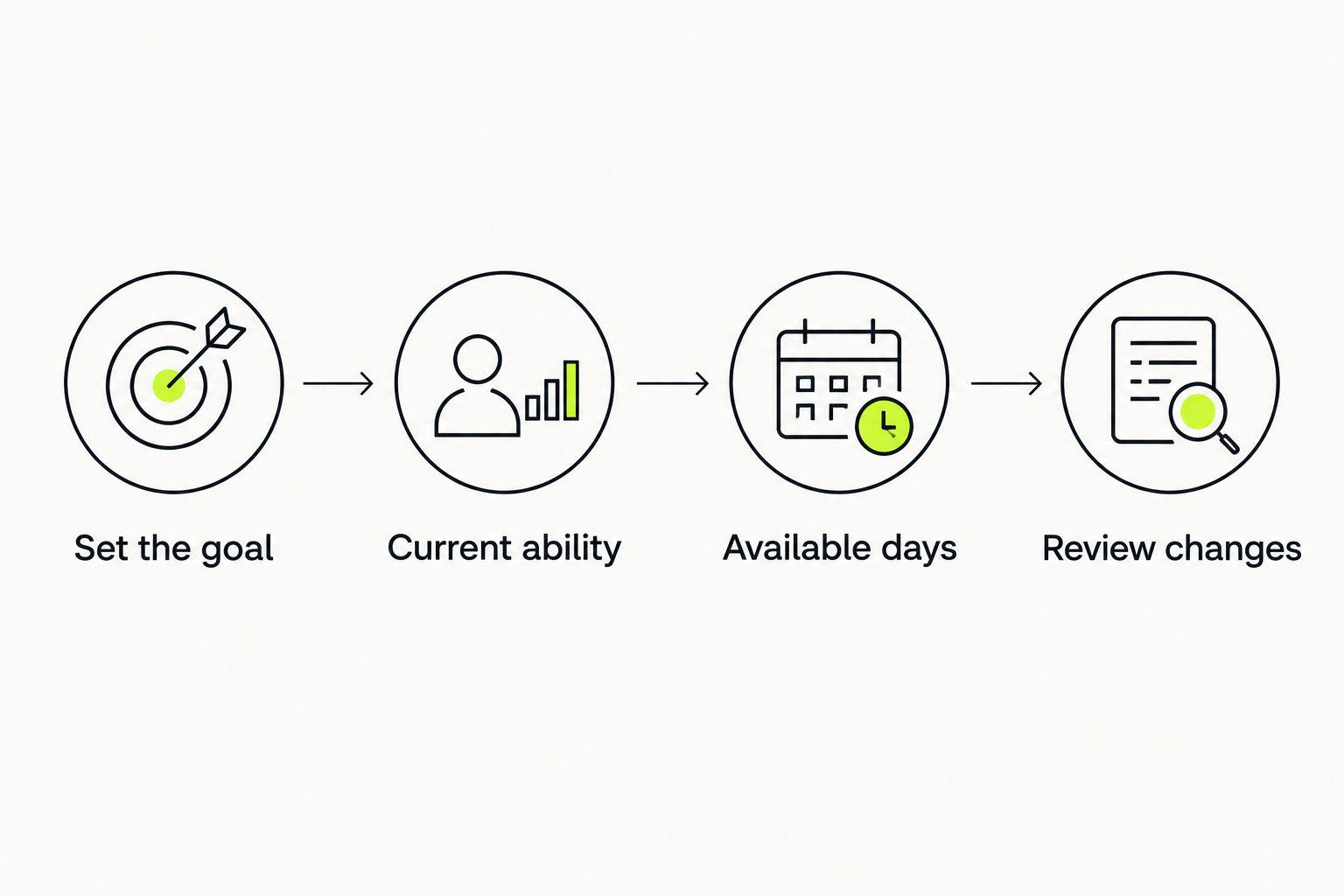
How to replace your printed plan without creating confusion
Switching tools should simplify your training. Do not carry over every unfinished workout and ask the new schedule to accommodate it. Start with an honest picture of where you are now.
1. Set the goal
Enter the race you are preparing for and the goal you can explain plainly. Finishing your first marathon and pursuing a specific finish time are different planning conversations.
Use your actual race date in 2026, not the date you originally hoped to target. The remaining preparation time is part of the decision, not a detail to fix later.
2. Describe your current ability
Use your recent running, not your strongest period from memory. Include the sessions you have actually completed and whether they felt manageable.
Do not turn an unusually good run into your normal starting point. A plan should meet your present ability before asking you to build on it.
3. Enter available days
Choose the days you can protect in a normal week. Include work, family commitments, and the practical space needed for a longer outing.
If weekends are unpredictable, say so through the scheduling options available. An ambitious calendar that repeatedly clashes with your life is not a useful upgrade from paper.
4. Review changes
Read the new schedule before following it. Check the next run, the surrounding sessions, and how the plan handles a day you cannot make.
Use one plan as your training schedule. Keep the printed version as a reference if you like, but do not add its workouts to the app's instructions.
Why the right choice varies
The right marathon training app in 2026 is not automatically the one another runner prefers. Your choice depends on the decisions you need help making.
- Current ability: A plan that starts beyond your recent running is a poor fit, whether it appears on paper or a phone.
- Available days: A predictable routine makes a fixed schedule easier to follow. Changing shifts create more scheduling decisions.
- Race goal: Your plan should reflect the event and outcome you are preparing for, rather than a generic calendar.
- Need for explanation: Some runners want the next session. Others need help understanding why it belongs there.
- Comfort with adjustments: Paper requires you to interpret changes. An adaptive app is relevant when you want help revising the plan.
- Device preference: Kiki is a marathon training app for iPhone. A printed schedule does not require a particular phone.
None of these factors guarantees a race result. They help you choose a format you can use consistently and understand when circumstances change.
What happens if I miss a run?
A missed run does not automatically belong in the next empty space on your calendar. First identify why you missed it, then review what is already scheduled around it.
If a work meeting caused the problem, the decision concerns scheduling. If the session felt too hard, the question concerns workload. If something hurts, stop treating the problem as a calendar puzzle and seek appropriate professional advice.
Do not stack sessions simply to restore a completion streak. Use the plan's adjustment guidance and inspect the revised week. The guide to adjusting a personalized running plan after a missed run explains the decision in more detail.
Can I keep the printed plan as well?
Yes. Keep paper as an overview or a place to record notes, but choose one source for workout instructions. Two competing schedules create extra decisions rather than extra training value.
A useful paper note records what happened: tired, too hard, could not make it, or felt comfortable. That is more informative than a tick alone. Keep those observations available when reviewing your next session.
Should I choose an app or a human coach?
Choose an app when you want a structured plan and help adapting it within the app's features. Consider a human coach when you want a person to discuss your training decisions, competing priorities, and race expectations with you.
Neither option replaces medical assessment. If pain or illness is driving repeated changes, the next step is not simply finding a more flexible calendar.
Try the decision before committing to the format
Before moving your 2026 marathon preparation into an app, test the questions that usually disrupt your training. Ask what you would do if a work commitment took your running day, the previous session felt too hard, or the proposed schedule did not match your availability.
The answers should be understandable. You should not need to guess whether the plan changed or whether you are still expected to complete everything.
For an iPhone runner who wants that adaptive approach, Kiki is a relevant option. Review how its personal plan fits your goal and available days before making it your main schedule.
Explore Kiki for iPhone
See how a personal running plan fits your goal, current ability, and available days.
FAQ
Can a marathon training app completely replace a printed plan?
Yes, a marathon training app can replace a printed plan when its workload, schedule, and guidance fit your needs. You do not need to follow a second plan alongside it.
Is Kiki suitable for someone training for a first marathon?
Kiki builds and adapts personal running plans for runners from beginners to marathoners. It is an iPhone option for first-marathon runners who want training organized around their goal, current ability, and available days.
Is a printed marathon plan a bad choice?
No, a printed marathon plan is a reasonable choice when its starting workload and schedule fit you. You remain responsible for interpreting missed sessions and deciding how to adjust.
Do all running apps adapt when I miss a workout?
No, displaying or recording workouts is not the same as adapting future training. Check the particular app's current features and its instructions for missed sessions.
Should I make up every missed marathon training run?
No, do not automatically add every missed run to the remaining schedule. Review why you missed it and what is already planned before deciding what changes.
Can I use Runna or Nike Run Club instead of paper?
Runna and Nike Run Club both offer running training plans. Compare their current marathon guidance and scheduling features with your needs rather than assuming either handles changes in a particular way.
Does using an app mean I can ignore pain during training?
No, an app's scheduled workout is not a reason to run through pain. Stop treating pain as a scheduling problem and seek appropriate professional advice.
One last thing
Before your next run, write down why that session belongs in your week. If the only answer is that the box is still unchecked, review the plan rather than chasing the tick.
Replace paper when you need better decisions, not just a different display. A useful plan earns its place when your week changes.


